CV17 (Shanzhong) — Chest Center
CV17, known as Shanzhong or Chest Center, is the front Mu point of the Pericardium. It is used for breathing difficulties, chest tightness, anxiety and emotional release — and for the palpitations and restless feeling that often go with a tense chest.
At a Glance
| Meridian | Conception Vessel (CV / Ren) |
|---|---|
| Body region | Center of the chest, on the sternum at the level of the nipples (4th intercostal space) |
| Best for | Chest tightness and shallow breathing, anxiety and emotional release, palpitations |
| Difficulty | Very easy to reach; gentle pressure on the sternum with fingertips or a palm |
| Hold time | 30–60 seconds, or 1–2 minutes for a deeper feel |
| Frequency | 1–3 times daily |
| Pairs well with | HT7 (Shenmen), CV22 (Tiantu), PC6 (Neiguan) |
| Skip if | Recent sternum or chest injury, or broken skin over the point (see Precautions) |
Why CV17 Matters
CV17 sits on the midline of the sternum at about nipple height, and that central position gives it an outsized role in acupressure practice. Because it lies on the Conception Vessel, it is classically described as the point where the chest qi gathers — a natural focus whenever the goal is respiratory comfort, emotional release, or calming restless breathing. Its landmark is simple: the midpoint of a line between the two nipples, at the level of the fourth rib space on the breastbone.
Anxiety often shows up as shallow, tense breathing, a tight chest, and a racing or fluttering heartbeat — which is exactly the territory CV17 is used for. Gentle pressure here, combined with slow, even breathing, can encourage the body to ease and is a common self-care step used alongside professional care. In traditional formulas it is paired with HT7 for calm and PC6 for chest and heart discomfort, and because it sits directly on the sternum it responds to the flat of the fingertips or the warmth of a palm rub rather than a hard knuckle.
Where Is This Point Located?
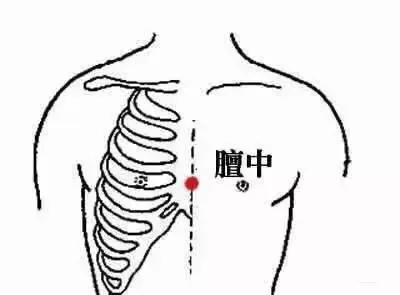
CV17 is located on the midline of the sternum (breastbone), at the level of the fourth intercostal space, approximately at nipple height in most people. The simplest landmark is the midpoint of the imaginary line between the two nipples. Because the point sits directly on bone, it responds best to the flat of one or two fingertips or the heel of the palm rather than a hard knuckle.
Three quick confirmations you have the right spot: (1) it is exactly on the center line of the breastbone, halfway between the nipples; (2) pressing produces a deep, slightly tender sensation on the bone — never a sharp pinch; (3) it is on the sternum itself, not over the ribs or breast tissue to either side.
When to Use CV17 (and When Not)
Use it when
- • Your chest feels tight, heavy, or hard to breathe into fully
- • You feel anxious, stressed, or emotionally shut down
- • You notice a fluttering or racing heartbeat that comes with tension
- • You want a calming point before sleep, a meeting, or a stressful event
Hold off if
- • You recently injured the sternum, ribs, or chest, or had chest surgery
- • There is broken skin, a rash, or tenderness over the point itself
- • Chest pain is new, severe, or different from what you usually feel
- • You have a known heart condition — check with your clinician first
Use the Hold off column as a safety filter: CV17 is a comfort practice for tension and mild breathing tightness, not a response to chest pain or breathing emergencies — those need medical attention, not pressure.
What Are the Benefits?
- Breathing support: CV17 relieves chest tightness, shortness of breath, and asthma symptoms.
- Emotional release: It is the point for releasing grief, sadness, and suppressed emotions stored in the chest.
- Anxiety and stress: CV17 calms the heart and mind, reducing anxiety and panic sensations.
- Palpitations: It helps settle a fluttering or racing heartbeat that comes with tension.
- Hiccups and cough: CV17 can help stop persistent hiccups and soothe dry or spasmodic coughs.
How Do You Use This Point?
Keep the pressure gentle, work at roughly 90 degrees to the skin, and press around breast tissue rather than directly over it. The sternum is bone, so the flat of the fingertips or the palm works better than a pointy knuckle.
Step-by-step technique
- Lie down or sit comfortably with your chest exposed.
- Place two or three fingertips of one hand on the CV17 point.
- Apply gentle to moderate pressure in a small circular motion.
- Breathe deeply for 1–2 minutes while maintaining contact.
- Use a palm rub in a clockwise motion over the sternum to finish.
Common mistake to avoid: pressing hard enough to bruise or to feel the sternum "digging back." The target sensation is a deep, dull, full ache on the bone — if it feels sharp or tender the next day, use noticeably less force and let the breathing do the work.
Combine CV17 with These Points
A full chest-and-calm routine is more effective than pressing one point. Pick the row closest to your situation and work the points in the order shown, 30–60 seconds each.
| Goal / symptom | Routine (in order) |
|---|---|
| Chest tightness or shallow breathing | CV17 → CV22 → PC6, then a few slow, full breaths with hands on the chest |
| Anxiety or a racing, fluttering heartbeat | CV17 → HT7 → PC6, holding each 60s, then slow exhales |
| Emotional heaviness or grief | CV17 → HT7 → CV6, combined with calm breathing for up to 3 minutes |
| Difficulty falling asleep from a tense chest | CV17 → HT7 → Yintang before bed, each 30–60s lying down |
For a fuller program, see the chest acupressure points body guide and our acupressure for anxiety page.
What to Expect
First session (today)
The point may feel tender on the sternum. Most people notice their breathing slowing and the chest feeling looser within a few minutes, especially when pressure is combined with slow exhales. Do not expect a cure after one press.
Days 3–7 (consistent daily practice)
With 1–2 sessions per day, the chest usually feels less reactive to stress and it becomes easier to take a full breath during tense moments. This matches the pattern in studies of acupressure for anxiety and respiratory comfort, where benefits build over several days of regular use.
Weeks 2–4
For ongoing anxiety or stress-related chest tightness, keep CV17 as one tool alongside exercise, sleep, and professional care. If chest pain, palpitations, or shortness of breath appear or worsen at any point, stop self-treatment and see a clinician — acupressure never replaces medical care for heart or lung symptoms.
What Does the Research Say?
Evidence on acupressure for anxiety, respiratory comfort, and musculoskeletal tension has grown in recent years. Systematic reviews and randomized controlled trials have examined acupressure as an adjunct for these conditions, with results that are generally promising but limited in quality. Meta-analyses of acupressure for pain and stress tend to show a positive direction of effect, though many of the included studies are small and their methodological quality varies considerably.
Researchers consistently note that acupressure trials are hard to blind, because the treatment is physical and participants can usually tell whether they are being treated. This makes it difficult to separate the specific effects of a particular point from the general benefits of touch, pressure, and relaxation. The overall picture — which we discuss in detail on our does acupressure work? review — is one of encouraging signals alongside a clear need for larger, higher-quality studies before firm conclusions can be drawn. For chest and anxiety-related symptoms, acupressure is best understood as a low-risk comfort measure that supports, but never replaces, professional care.
Acupressure has been evaluated in clinical trials for pain, nausea, anxiety, and sleep, with evidence described as promising but requiring further high-quality research.
— Song HJ, Seo HJ, Lee H, Son H, Choi SM, Lee S. Complementary Therapies in Medicine. 2015;23(1):68-78. PMID 25637155.
Verifiable sources
- Song HJ, Seo HJ, Lee H, Son H, Choi SM, Lee S. Effect of self-acupressure for symptom management: a systematic review. Complementary Therapies in Medicine. 2015;23(1):68-78. PMID 25637155 · DOI
- Chen HM, Wang HH, Chiu MH, Hu HM. Effects of acupressure on anxiety: a systematic review and meta-analysis. Journal of Alternative and Complementary Medicine. 2022;28(5):514-524. PMID 35235358
The reviews above evaluated self-acupressure for respiratory complaints and for anxiety, the two uses of CV17. Neither is a study of CV17 in isolation.
Are There Safety Concerns?
- Use gentle pressure on the sternum — the bone is sensitive and excessive force can cause bruising.
- Avoid if you have a recent chest injury, rib fracture, sternum injury, or chest surgery.
- Do not apply pressure if you have skin conditions, rashes, or burns on the chest.
- Consult a healthcare provider if you have a known heart condition before using this point.
- Seek medical attention if you ever feel chest pain or new shortness of breath instead of pressing.
Red Flags — See a Professional
Stop self-treatment and see a doctor if you notice any of the following:
- Sudden, severe, crushing, or spreading chest pain or pressure
- Shortness of breath that comes on suddenly or gets worse
- Palpitations that feel fast, irregular, or last longer than a few seconds
- Pain, tightness, or pressure that spreads to the arm, jaw, neck, or back
- Fainting, dizziness, cold sweats, or a feeling of doom with chest symptoms