CV22 (Tiantu) — Celestial Chimney
CV22, known as Tiantu or Celestial Chimney, sits in the hollow above the breastbone. It is a first-line point for coughs, sore throats, hoarseness, and the urge to clear the throat — and because it sits close to the windpipe, it must be pressed very lightly and briefly.
At a Glance
| Meridian | Conception Vessel (CV / Ren) |
|---|---|
| Body region | Center of the hollow above the breastbone (suprasternal notch) |
| Best for | Cough, sore throat, hoarseness, throat clearing |
| Difficulty | Very easy to find — but requires the lightest touch of any point on the site |
| Hold time | 10–20 seconds, very light |
| Frequency | A few short sessions daily, as needed |
| Pairs well with | LU7 (Lieque), CV17 (Shanzhong), LI4 (Hegu) |
| Skip if | Thyroid problems, recent throat or neck surgery, or trouble swallowing — and never press deeply (see Precautions) |
Why CV22 Matters
CV22 is a point on the Conception Vessel, the meridian that runs down the midline of the front of the body and is classically associated with the throat, chest, and breathing. Its name — Celestial Chimney — captures its position at the very top of the windpipe, in the dip where the collarbones meet just above the breastbone. Because it sits so close to the airway, traditional practice uses it for anything that blocks or irritates the throat: a dry tickle, a hoarse voice, a stubborn cough, or a feeling that something needs to be cleared.
The point is remarkably easy to reach — you can press it at a desk, in a car, or before giving a presentation — and it responds to very light touch. Speakers, singers, and anyone with a throat-clearing habit often find that a few seconds of gentle pressure settles the reflex. Because of the nearby windpipe, the guidance here is more about gentleness than force: a light fingertip hold rather than deep pressure is the correct technique, and short sessions are safer and often just as effective.
Where Is This Point Located?
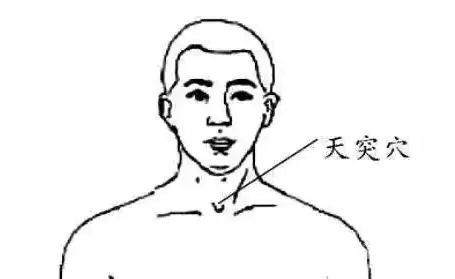
CV22 sits in the suprasternal notch — the soft, V-shaped hollow at the base of the front of the throat, between the inner ends of the two collarbones and directly above the breastbone. To find it, tip your head back slightly and run a finger down the front of your neck; you will feel the notch where the neck meets the chest. The point is at the center of that hollow. It is not on the Adam's apple (which sits higher) and not on the windpipe itself — it is the dip just above the breastbone.
Three quick confirmations you have the right spot: (1) tip the head back and run a finger down the front of the neck — the point is the soft V-shaped dip just above the breastbone, not the Adam's apple; (2) it is in the exact midline, between the inner ends of the collarbones; (3) pressing it gently produces a slight fullness or tickle sensation — if you feel pressure on the windpipe itself, you are too deep or too high.
When to Use CV22 (and When Not)
Use it when
- • A dry, tickly cough is building
- • Your throat feels scratchy or sore
- • Your voice is hoarse or tired after speaking, singing, or shouting
- • You keep needing to clear your throat
Hold off if
- • You have a thyroid condition or swelling at the front of the neck
- • You recently had throat, thyroid, or neck surgery
- • Swallowing is painful or difficult, or you have a high fever
- • There is skin irritation, a rash, or swelling over the point
Use the Hold off column as a safety filter: CV22 is a point for gentle throat comfort — never deep pressure — and a painful or persistent sore throat needs a clinician rather than more pressing.
What Are the Benefits?
- Cough: CV22 is traditionally used to soothe coughing and the urge to cough from a tickly throat.
- Sore throat: It may help ease throat discomfort and a dry, scratchy sensation.
- Hoarseness and voice strain: It is a favorite point for singers and speakers with a tired or weak voice.
- Difficulty swallowing: It is used for the sensation of a lump or mild discomfort when swallowing.
- Throat clearing: It helps settle a nervous or habitual need to clear the throat.
For a complete step-by-step routine, see our anxiety acupressure guide.
How Do You Use This Point?
This point is close to the windpipe, so keep the touch light and the session short — a gentle fingertip hold of 10–20 seconds is plenty. Never press downward or backward into the throat.
Step-by-step technique
- Tilt your head back slightly to open the hollow above the breastbone.
- Place the pad of your index or middle finger in the center of the notch.
- Apply very light pressure straight onto the pad of the finger — not down toward the windpipe.
- Hold for 10–20 seconds while breathing slowly, then release.
- Repeat a few times a day as needed, keeping every session short and gentle.
Common mistake to avoid: pressing downward or backward toward the windpipe, or holding for too long. CV22 sits near the airway, so the correct technique is a light touch on the pad of the finger, held for seconds rather than minutes — if it feels uncomfortable at all, stop.
Combine CV22 with These Points
A throat routine works better than pressing one point. Pick the row closest to your situation and work the points in the order shown, keeping CV22 holds short and gentle.
| Goal / symptom | Routine (in order) |
|---|---|
| Dry tickly cough | CV22 → LU7 → CV17, light holds, plus warmth and fluids |
| Sore throat / first sign of a cold | CV22 → LU7 → LI4, gentle 10–20s holds, repeated through the day |
| Hoarse or tired voice | CV22 → CV17, short gentle holds, with voice rest and sips of warm water |
| Stuffy nose with a cough | CV22 → LI20 → LU7 |
CV22 lives on the chest acupressure points body guide. For a fuller cold-care program, the head acupressure points guide adds GB20 and LI20 to round out the routine — and review the evidence on our does acupressure work? page.
What to Expect
First session (today)
With a light 10–20 second hold, the throat often feels a little calmer within moments. The urge to clear may briefly strengthen before settling — that is normal. Do not expect a single press to stop a cold in its tracks.
Days 3–7 (consistent daily practice)
A few short, gentle sessions a day can ease a tickly cough and hoarseness as part of your usual cold or voice care. Keep every session brief — with CV22, gentleness and brevity are the technique, not a compromise.
Weeks 2–4
A cough or sore throat that lasts more than a week or two, or that is getting worse, needs a clinician. CV22 is comfort care, not a treatment for respiratory or throat conditions.
What Does the Research Say?
Systematic reviews and randomized controlled trials have examined acupressure as an adjunct for respiratory and pain conditions, with results that are generally promising but limited in quality. Studies looking at points around the neck and chest have reported that gentle pressure may help ease throat discomfort, coughing, and congestion, but the trials are small and use varied techniques, so the evidence is not conclusive. Our overview of the current evidence for acupressure explains what the research can and cannot tell us.
The direction of the evidence is positive: acupressure appears to be a low-risk, low-cost self-care option that some people find genuinely helpful for respiratory symptoms and voice fatigue. Because CV22 sits close to the airway, the most important lesson from the research is caution — gentle, short stimulation is the safe approach, and persistent throat problems, pain on swallowing, or a worsening cough should always be checked by a doctor.
Acupressure has been evaluated in clinical trials for pain, nausea, anxiety, and sleep, with evidence described as promising but requiring further high-quality research.
— Song HJ, Seo HJ, Lee H, Son H, Choi SM, Lee S. Complementary Therapies in Medicine. 2015;23(1):68-78. PMID 25637155.
Verifiable sources
- Song HJ, Seo HJ, Lee H, Son H, Choi SM, Lee S. Effect of self-acupressure for symptom management: a systematic review. Complementary Therapies in Medicine. 2015;23(1):68-78. PMID 25637155 · DOI
The review above assessed self-acupressure across respiratory complaints. It is not a study of CV22 in isolation, but CV22 is the point most commonly used for cough and throat relief.
Are There Safety Concerns?
- Use only very light, brief pressure — never press downward or backward toward the windpipe.
- Avoid the point after recent throat, thyroid, or neck surgery, or if you have a known neck condition.
- Avoid the point if you have a thyroid condition affecting the front of the neck.
- Skip it if there is swelling, pain, or skin irritation at the front of the neck, or if swallowing is difficult.
- Stop if you feel a gag reflex, difficulty breathing, or any discomfort; seek medical care for a painful or persistently sore throat.
Red Flags — See a Professional
Stop self-treatment and see a doctor if you notice any of the following:
- Difficulty breathing or swallowing
- A high fever with a sore throat
- A sore throat that lasts more than a few days or keeps getting worse
- A visible lump or swelling in the neck
- Hoarseness lasting more than 2–3 weeks (see a doctor or ENT specialist)