Yintang — Hall of Impression
Yintang, known as the Hall of Impression, is one of the most well-known extra points. Located between the eyebrows, it is a go-to point for calming the mind, relieving anxiety, and quieting a racing mind.
At a Glance
| Meridian | Extra point (not on a standard meridian) |
|---|---|
| Body region | Between the eyebrows, where the bridge of the nose meets the forehead |
| Best for | Anxiety, stress, insomnia, mental focus, eye strain |
| Difficulty | Extremely easy — one fingertip, no anatomy to learn |
| Hold time | 60–90 seconds, up to 2 minutes |
| Frequency | 1–3 times daily |
| Pairs well with | HT7 (Shenmen), Taiyang, LI4 (Hegu) |
| Skip if | Recent eye surgery, a nasal bone fracture, or broken skin on the forehead or around the eyes (see Precautions) |
Why Yintang Matters
Yintang is perhaps the most accessible anxiety-relief point on the body. It sits directly between the eyebrows, so there is no complex anatomy to learn and no awkward position to hold — you can press it at a desk, in bed, or during a stressful moment. In meditation traditions it is often called the "third eye" point, and its name, Hall of Impression, reflects its role as a gateway for the mind.
Yintang stimulation activates the prefrontal cortex and promotes the shift from beta waves (active thinking) to alpha waves (relaxed awareness), the first step toward sleep. Because it is a single, central point rather than a pair, there is no "right or left side" to remember — one fingertip in the middle of the brow is the whole technique.
Where Is This Point Located?
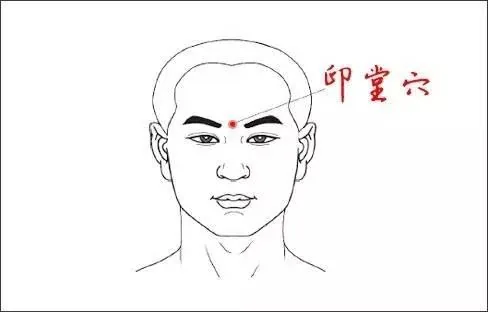
Yintang is located on the forehead, midway between the inner ends of the eyebrows (glabella), directly above the nose. It is a well-known extra point and not part of a specific meridian. Run a fingertip straight down between your eyebrows and you will feel a small depression where the bridge of the nose meets the forehead — that is the point.
Three quick confirmations you have the right spot: (1) it is the small dip exactly midway between the inner ends of the eyebrows; (2) pressing it produces a soft, tender, slightly "tight" sensation rather than a deep ache; (3) both inner eyebrow ends point toward the same spot, so you should feel it clearly in the center rather than off to one side.
When to Use Yintang (and When Not)
Use it when
- • Your mind is racing and you feel anxious or wired
- • You are trying to wind down for sleep and cannot switch off
- • Focus and concentration flag after long hours on a screen
- • Your eyes feel tired or strained after close work
Hold off if
- • You recently had eye surgery or an injury around the eye socket
- • There is broken skin, a pimple, or a rash on the point
- • You have a nasal bone fracture or a recent head injury
- • Pressure makes you dizzy or brings on a headache
Use the Hold off column as a safety filter: Yintang is a gentle calming practice — it should feel soothing, not forceful, and it is not a substitute for medical care for anxiety or insomnia.
What Are the Benefits?
- Anxiety and stress: Yintang is one of the most effective points for calming nervousness and anxious thoughts.
- Insomnia: It quiets a racing mind and helps prepare the body for restful sleep.
- Mental clarity: Yintang improves concentration and focus, especially after long screen exposure.
- Eye strain: It relieves eye fatigue and tension headaches from prolonged computer or phone use.
- Frontal pressure: Pressed gently, it eases the "band of tension" feeling across the forehead that often accompanies stress.
How Do You Use This Point?
This point responds well to longer holds — up to 2 minutes. Close your eyes and visualize tension releasing from your forehead with each exhale.
Step-by-step technique
- Sit comfortably in a quiet space with your eyes closed.
- Place your index or middle fingertip on the Yintang point.
- Apply gentle, steady pressure in a small circular motion.
- Breathe deeply for 1–2 minutes while maintaining contact.
- Use before bed, meditation, or during stressful moments.
Common mistake to avoid: pressing hard or using a knuckle. Yintang responds to light, steady fingertip pressure — the goal is a soft settling sensation, and pressing so hard that it hurts can actually create a headache.
Combine Yintang with These Points
A calming routine is more effective than pressing one point. Pick the row closest to your situation and work the points in the order shown.
| Goal / symptom | Routine (in order) |
|---|---|
| Anxiety / racing mind | Yintang → HT7, 1–2 minutes each, with slow breathing |
| Trouble falling asleep | Yintang → HT7, as the opening of a bedtime routine |
| Eye strain after screens | Yintang → Taiyang, gentle circles, then rest the eyes |
| Frontal headache / sinus pressure | Yintang → LI4 → GB20, 30–60s each |
For a fuller program, see the head acupressure points and face acupressure points body guides, and our acupressure for anxiety and acupressure for sleep pages.
What to Expect
First session (today)
Within a minute, most people feel the forehead soften and breathing slow. It is common to feel calmer immediately after — and for the effect to be short-lived on the first try. Do not expect a single press to remove a whole day of stress.
Days 3–7 (consistent daily practice)
Used daily, especially before bed or before stressful events, Yintang helps build a calmer baseline. This matches the pattern in studies of acupressure for anxiety, where benefits strengthen with regular practice over several days.
Weeks 2–4
For anxiety or insomnia, combine Yintang with sleep hygiene and stress-management habits. Acupressure is a complement, not a replacement — persistent or worsening anxiety and insomnia deserve professional support rather than more pressing.
What Does the Research Say?
Systematic reviews and randomized controlled trials have examined acupressure for anxiety and stress, with results that are generally promising but limited in quality. Studies of acupressure for situational and preoperative anxiety tend to report meaningful reductions in anxiety scores compared with no treatment, and Yintang appears in many of these protocols as one of the points being studied. You can read a fuller assessment of what this evidence does and does not show on our does acupressure work? page.
Like all acupressure research, trials are hard to blind because the treatment is physical, which makes it difficult to separate the specific effects of the point from the general benefits of touch and relaxation. The overall picture is encouraging but not definitive. For anxiety specifically, our acupressure for anxiety page summarizes the strongest available evidence.
Acupressure has been evaluated in clinical trials for pain, nausea, anxiety, and sleep, with evidence described as promising but requiring further high-quality research.
— Chen HM, Wang HH, Chiu MH, Hu HM. Journal of Alternative and Complementary Medicine. 2022;28(5):514-524. PMID 35235358.
Verifiable sources
- Chen HM, Wang HH, Chiu MH, Hu HM. Effects of acupressure on anxiety: a systematic review and meta-analysis. Journal of Alternative and Complementary Medicine. 2022;28(5):514-524. PMID 35235358
- Liao CC, Liao KR, Lin CL, Li JM. Effects of acupressure on sleep quality and psychological distress in nursing home residents: a randomized controlled trial. Journal of the American Medical Directors Association. 2020;21(12):1958-1965. PMID 32409141
- Hsieh LL, Liou HH, Lee LH, Chen TH, Yen AM. Effect of acupressure and trigger points in treating headache: a randomized controlled trial. American Journal of Chinese Medicine. 2010;38(1):1-14. PMID 20128040 · DOI
The reviews and trial above evaluated acupressure for anxiety, sleep, and headache, the three uses of Yintang. None is a study of Yintang in isolation.
Are There Safety Concerns?
- Use very gentle pressure — the area around the eyes and forehead is sensitive.
- Avoid if you have a recent head injury, sinus surgery, or fracture around the eye socket or nasal bone.
- Do not apply pressure if there are skin irritations, pimples, or rashes on the point.
- Keep pressure light after eye surgery or any recent facial procedure.
- Stop if you feel dizzy or develop a headache during massage.
Red Flags — See a Professional
Stop self-treatment and see a doctor or therapist if you notice any of the following:
- Anxiety or panic that is worsening or interfering with daily life
- Persistent insomnia that does not improve with sleep hygiene
- A sudden, severe headache, especially with vision changes or fever
- Dizziness or fainting during pressure
- Eye pain, redness, or changes in vision
Frequently Asked Questions
Where is Yintang and how do I find it?
How long and how often should I press Yintang?
Can Yintang help me fall asleep faster?
Is Yintang safe for children?
When should I see a professional instead?
Related guides: acupressure for stress relief and sinus pressure.