PC6 (Neiguan) — Inner Pass
PC6, known as Neiguan or Inner Pass, is the premier acupressure point for nausea and anxiety. Located on the inner forearm, it is widely recommended for motion sickness, morning sickness, and chemotherapy-related nausea — and it is the best-researched point on this site.
At a Glance
| Meridian | Pericardium (PC) |
|---|---|
| Body region | Inner forearm, about three of your own finger-widths below the wrist crease, between the two tendons |
| Best for | Nausea and vomiting, motion sickness, morning sickness, anxiety, chest tightness |
| Difficulty | Easy — make a loose fist to see the tendons, then press between them |
| Hold time | 30–60 seconds; 2–3 minutes sustained for nausea |
| Frequency | As needed, or 1–3 times daily |
| Pairs well with | ST36 (Zusanli), LI4 (Hegu), HT7 (Shenmen) |
| Skip if | An open wound on the wrist or forearm, or a recent wrist injury or surgery. Safe for pregnancy morning sickness, but check with your provider first. |
Why PC6 Matters
No acupressure point on the body has more accumulated research than PC6 has for nausea. It is the point most consistently studied for postoperative, chemotherapy-related, and motion-sickness nausea, and it is widely regarded as the single most useful point to know for queasiness of any cause. In traditional Chinese medicine, PC6 opens the chest and regulates the stomach, which matches its modern use for both nausea and the tight, constricted sensation that often accompanies anxious feelings.
PC6 sits on the Pericardium meridian, which in the traditional model protects the Heart and influences the upper digestive tract. On a practical level, its position on the inner forearm makes it easy to find, easy to press yourself, and easy to maintain with a wristband that delivers steady pressure — which is why it shows up in travel, hospital, and home routines alike.
Where Is This Point Located?
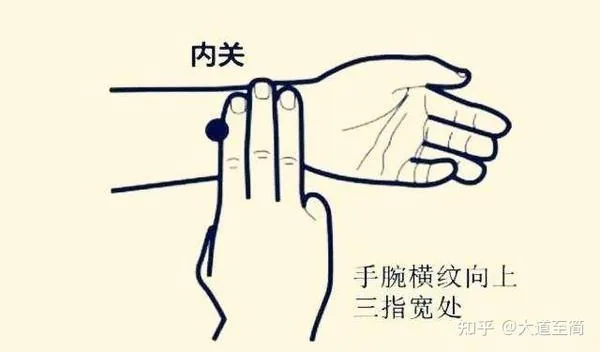
PC6 is on the inner forearm, approximately 2 cun (about three finger-widths) below the wrist crease, between the two prominent tendons (palmaris longus and flexor carpi radialis). It lies on the Pericardium meridian. When you make a loose fist, the two tendons become more visible, which makes the point easier to locate.
Three quick confirmations you have the right spot: (1) it sits between the two visible tendons, not on them; (2) it is about three of your own finger-widths from the wrist crease; (3) pressing it produces a deep, dull ache — if you feel an electric jolt or tingling into the palm, you have drifted off the point.
When to Use PC6 (and When Not)
Use it when
- • You feel nauseous, queasy, or carsick
- • You are about to travel and want to prevent motion sickness (press 20–30 minutes before)
- • You are pregnant and dealing with morning sickness (with your provider's OK)
- • You feel anxious, with tightness or pressure in the chest
Hold off if
- • There is a cut, wound, rash, or recent surgery on the wrist or forearm
- • You have severe chest pain, pressure, or breathlessness — this needs emergency care, not acupressure
- • Pressure causes tingling or numbness into the hand
- • You are pregnant: PC6 is safe for morning sickness, but check with your midwife or doctor first
Use the Hold off column as a safety filter: PC6 is superb for nausea, but sudden chest pain or pressure is never something to self-treat.
What Are the Benefits?
- Nausea and vomiting: The best-researched point on this site — used for motion sickness, morning sickness, and chemotherapy-related nausea.
- Anxiety and stress: PC6 calms the mind and may help reduce symptoms of panic and general anxiety.
- Post-surgery recovery: It is commonly used in hospitals to reduce post-operative nausea.
- Chest tightness: PC6 relieves chest pressure, palpitations, and breathlessness of an anxious kind.
- Digestive upset: It helps regulate stomach qi and can ease indigestion and hiccups.
How Do You Use This Point?
For nausea, use a firmer, more sustained hold of 2–3 minutes with slow, deep breathing — nausea often requires deeper stimulation than anxiety or sleep work.
Step-by-step technique
- Hold your arm with the palm facing up.
- Place your opposite thumb on PC6, between the two tendons.
- Apply firm pressure with your thumb while gently rotating your wrist.
- Hold for 30–60 seconds, breathing slowly and deeply.
- Repeat on the other arm as needed.
Common mistake to avoid: pressing on the tendons or digging in so hard that you feel an electric jolt into the hand. The point lies between the two tendons, and nausea wants a firm, sustained hold rather than quick rubbing — a wristband with a firm stud can maintain that pressure for hours.
Combine PC6 with These Points
A nausea or anxiety routine is more effective than pressing one point. Pick the row closest to your situation and work the points in the order shown, 30–60 seconds each.
| Goal / symptom | Routine (in order) |
|---|---|
| Nausea / motion sickness | PC6 → LI4 → ST36, starting 20–30 minutes before travel |
| Anxiety / tight chest | PC6 → HT7 → LI4, holding each 60s with slow breathing |
| Morning sickness (pregnancy) | PC6 only, gently, with your provider's OK — avoid LI4 and SP6 during pregnancy |
| Post-meal queasiness | PC6 → ST36 → CV12, after waiting 30–60 minutes past the meal |
For a complete nausea plan, see our acupressure for nausea page and the arm & wrist acupressure points body guide. PC6 is also used for stress and anxiety: see our stress relief guide. PC6 is also used for tinnitus and high blood pressure support: see our tinnitus and high blood pressure guides.
What to Expect
First session (today)
Many people feel relief from nausea within 2–5 minutes of sustained PC6 pressure, which is why it is the go-to point for travel sickness. If the point feels very tender, ease off a notch — tenderness in the inner wrist is common.
Days 3–7 (consistent daily practice)
With 1–3 short sessions per day, anxiety-related chest tightness and frequent queasiness often ease. This matches the pattern in studies of acupressure for nausea and anxiety, where benefits appear after several days of regular use.
Weeks 2–4
For persistent anxiety or nausea, keep PC6 as part of a broader plan that may include medical care. Acupressure is a complement, not a replacement — persistent vomiting, chest pain, or anxiety that interferes with daily life should be evaluated by a clinician rather than managed with acupressure alone.
What Does the Research Say?
PC6 is the best-researched acupressure point on this site. The nausea evidence is unusually strong for a complementary therapy: PC6 stimulation for nausea and vomiting — postoperative, chemotherapy-related, and motion sickness — has been examined in systematic reviews and Cochrane reviews that synthesize dozens of randomized trials. Results are generally positive, with acupressure shown to work alongside standard anti-emetic treatment rather than replacing it.
Researchers still note that acupressure trials are hard to blind, because the treatment is physical and participants can usually tell whether they are being treated — though the very consistency of the nausea findings across many trials is what makes PC6 stand out. The overall picture — which we discuss in detail on our does acupressure work? review — is one of strong encouraging signals for nausea, alongside a clear need for larger, higher-quality studies before firm conclusions can be drawn for other symptoms. For the full nausea routine, see our acupressure for nausea guide.
Acupressure has been evaluated in clinical trials for pain, nausea, anxiety, and sleep, with evidence described as promising but requiring further high-quality research.
— Lee A, Fan LTY. Cochrane Database of Systematic Reviews. 2009;(2):CD003281. PMID 19370583.
Verifiable sources
- Lee A, Fan LTY. Stimulation of the wrist acupuncture point P6 for preventing postoperative nausea and vomiting. Cochrane Database of Systematic Reviews. 2009;(2):CD003281. PMID 19370583 · DOI
- Chen HM, Wang HH, Chiu MH, Hu HM. Effects of acupressure on anxiety: a systematic review and meta-analysis. Journal of Alternative and Complementary Medicine. 2022;28(5):514-524. PMID 35235358
PC6 is the single best-documented point on this site. The Cochrane review directly studies stimulation at the P6/PC6 point on the inner wrist, and the meta-analysis above covers acupressure for anxiety, PC6's second main use.
Are There Safety Concerns?
- Apply gentle pressure — avoid pressing too hard on the tendons or nerves.
- Avoid if you have a wrist injury, carpal tunnel syndrome, or recent surgery in the area.
- Do not press over broken skin, cuts, or rashes on the wrist.
- Pregnant women may use PC6 for morning sickness, but consult your healthcare provider first.
- Stop if you experience numbness, tingling, or sharp pain.
Red Flags — See a Professional
Stop self-treatment and see a doctor if you notice any of the following:
- Sudden chest pain, pressure, or severe breathlessness — this needs emergency care, not acupressure
- Persistent vomiting, or the inability to keep down fluids
- Blood in vomit, or nausea with a severe headache
- Nausea or anxiety that gets worse or interferes with daily life
- Symptoms that have not improved after 2–3 weeks of regular acupressure