BL13 (Feishu) — Lung Shu
BL13, known as Feishu or the Lung Shu point, sits on the upper back beside the third thoracic vertebra. It is the classic back point for coughs, asthma, colds, nasal congestion, and supporting the lungs through cold season.
At a Glance
| Meridian | Bladder (BL) |
|---|---|
| Body region | Upper back, about two finger-widths beside the third thoracic vertebra (T3) |
| Best for | Cough, asthma and wheezing, colds and nasal congestion, weak lungs and immunity |
| Difficulty | Easy with a partner or a thumb hooked around from the side |
| Hold time | 1–2 minutes per side |
| Frequency | 1–2 times daily |
| Pairs well with | CV22 (Tiantu), LU7 (Lieque), GV14 (Dazhui) |
| Skip if | Recent back or spine injury, or acute, severe chest pain — see a doctor instead (see Precautions) |
Why BL13 Matters
BL13 is a Shu (Back-Shu) point on the Bladder meridian, and Back-Shu points are where the energy of each organ gathers on the back. The Lung Shu is the back point for the lungs, and in traditional practice it is used both to assess and to support respiratory health — a tender spot here is often read as a sign that the lungs or respiratory system are under strain. Because it sits beside the upper spine, it is also a natural place for tension to collect when a cough has been going on for a while, with the muscles between the shoulder blades tightening as you repeatedly cough or breathe shallowly.
Shu points are traditionally regarded as nourishing — they are used to strengthen, or tonify, the organ they correspond to, rather than only to relieve acute symptoms. That makes BL13 the point to return to again and again during cold season, for a lingering cough, or whenever you feel run down and prone to chest infections. It is a favorite point for wintertime self-care: press it after a chill, before travel, or at the first tickle in the throat, and pair it with GV14 for the first signs of a cold. Because it sits on the back, it is one of the easiest points to combine with a partner or a smooth massage tool.
Where Is This Point Located?
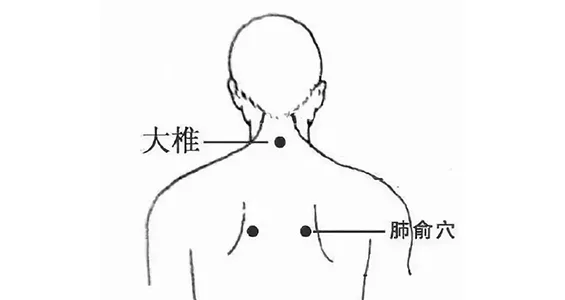
BL13 is on the upper back, roughly one and a half finger-widths (cun) out from the lower edge of the spinous process of the third thoracic vertebra (T3) — about two finger-widths to each side of the spine. A good landmark: the third thoracic vertebra sits about level with the inner end of the spine of the shoulder blade (scapula). To find the point, tilt your head forward to feel the most prominent bump at the base of the neck (C7), then count down two more vertebral bumps to reach T3 — the tender spot a couple of finger-widths to either side of that bump is BL13.
Three quick confirmations you have the right spot: (1) you are in the muscle band beside the spine, not on the spinous process itself; (2) the level matches the inner edge of the shoulder blade; (3) pressing toward the spine produces a deep, dull, achy sensation rather than a sharp pinch on bone.
When to Use BL13 (and When Not)
Use it when
- • You have a cough, especially one that lingers after a cold
- • Your nose is congested or you feel a cold coming on
- • You feel run down, prone to chest infections, or low on respiratory reserve
- • You want a daily maintenance point through cold and flu season
Hold off if
- • You recently injured the back, spine, or ribs, or had back surgery
- • You have acute, severe chest pain or sudden difficulty breathing — get medical help
- • There is broken skin, a rash, or tenderness over the upper back
- • A fever is high and not settling, or you feel seriously unwell
Use the Hold off column as a safety filter: BL13 is a comfort practice for coughs and congestion, not first aid for chest pain or breathing emergencies.
What Are the Benefits?
- Cough: BL13 is a primary point for soothing coughs, especially ones that linger.
- Asthma and wheezing: It may help support easier breathing between episodes.
- Colds and flu: It is traditionally used at the start of a cold to support recovery.
- Nasal congestion: It helps relieve stuffiness and a blocked or runny nose.
- Weak lungs: As a Back-Shu point it is used to nourish and strengthen the respiratory system.
For a complete step-by-step routine, see our back pain acupressure guide.
How Do You Use This Point?
Because the point is on the back, it is easiest to work on while lying face down with help from a partner, or to reach it yourself with a thumb hooked around from the side. Start light and deepen gradually, working toward the spine.
Step-by-step technique
- Lie face down, or sit and have a partner locate the bumps of the upper spine.
- Place a thumb or the heel of the hand about two finger-widths beside the third thoracic vertebra.
- Apply pressure that starts light and deepens slowly, feeling for the muscles beside the spine.
- Press and knead gently in the direction of the spine for 1–2 minutes on each side.
- Repeat daily during cold season or whenever the chest feels congested.
Common mistake to avoid: pressing directly on the bony spinous processes themselves. The target is the muscle band beside the spine — if you feel bone grinding under your thumb, slide out a finger-width or two and stay on the soft tissue.
Combine BL13 with These Points
A full respiratory routine is more effective than pressing one point. Pick the row closest to your situation and work the points in the order shown, 30–60 seconds each.
| Goal / symptom | Routine (in order) |
|---|---|
| First sign of a cold | BL13 → GV14 → LU7, 30–60s each, up to 2–3 times on the first day |
| Lingering cough or chest congestion | BL13 → CV22 → CV17, keeping CV22 gentle and brief |
| Nasal congestion and stuffiness | BL13 → LI4 → LU7, holding each 60s for up to 3 minutes total |
| Weak lungs / cold-season maintenance | BL13 → GV14 → CV17 daily; add CV6 when energy is low |
For a fuller program, see the back acupressure points body guide and our does acupressure work? research review.
What to Expect
First session (today)
The point is often noticeably tender, especially during a cold. Most people feel a looser, more open sensation across the upper back and chest within a few minutes, though congestion can return as the day goes on. Do not expect a cure after one press.
Days 3–7 (consistent daily practice)
With 1–2 sessions per day, tenderness at the point usually eases and breathing often feels fuller and less effortful. This matches the pattern in studies of acupressure for respiratory symptoms, where benefits appear after several days of regular use.
Weeks 2–4
For chronic conditions such as asthma or easily-tired lungs, keep BL13 as a complement to your medical care — it supports respiratory comfort but never replaces prescribed treatment. A cough or chest complaint that has not improved after 2–3 weeks, or any acute chest pain, is a signal to see a clinician.
What Does the Research Say?
Evidence on acupressure for respiratory and musculoskeletal conditions has grown in recent years. Systematic reviews and randomized controlled trials have examined acupressure as an adjunct for pain and breathing-related complaints, with results that are generally promising but limited in quality. Back points such as the Lung Shu are common in studies of breathing and immune support, and several trials report that pressure at these points may ease cough, congestion, and chest tightness, though the studies are small and methodologically varied.
Researchers consistently note that acupressure trials are hard to blind, because the treatment is physical and participants can usually tell whether they are being treated. This makes it difficult to separate the specific effects of a particular point from the general benefits of touch, pressure, and relaxation. The overall picture — which we discuss in detail on our does acupressure work? review — is one of encouraging signals alongside a clear need for larger, higher-quality studies before firm conclusions can be drawn. For respiratory care, acupressure is best understood as a low-risk comfort measure that supports, but never replaces, medical treatment.
Acupressure has been evaluated in clinical trials for pain, nausea, anxiety, and sleep, with evidence described as promising but requiring further high-quality research.
— Song HJ, Seo HJ, Lee H, Son H, Choi SM, Lee S. Complementary Therapies in Medicine. 2015;23(1):68-78. PMID 25637155.
Verifiable sources
- Song HJ, Seo HJ, Lee H, Son H, Choi SM, Lee S. Effect of self-acupressure for symptom management: a systematic review. Complementary Therapies in Medicine. 2015;23(1):68-78. PMID 25637155 · DOI
The review above assessed self-acupressure across respiratory complaints. It is not a study of BL13 in isolation, but BL13 is the point most commonly used for lung and breathing support.
Are There Safety Concerns?
- Avoid BL13 if you have a recent spine, rib, or shoulder-blade injury, or recent back surgery.
- Do not press on the bony spinous processes themselves — work on the muscle beside the spine.
- Skip the area if there is skin irritation, a rash, or broken skin over the upper back.
- Do not use this point for acute, severe chest pain — that needs immediate medical care.
- Stop if you feel sharp pain, numbness, or tingling; seek medical care for difficulty breathing or a fever that is not settling.
Red Flags — See a Professional
Stop self-treatment and see a doctor if you notice any of the following:
- Sudden, severe, or crushing chest pain or pressure — seek emergency care
- Shortness of breath that gets worse, or difficulty catching your breath
- Coughing up blood, or a cough that lasts more than 3 weeks without improvement
- High fever, wheezing that does not settle, or signs of a serious respiratory infection
- Back or spine pain that appeared suddenly after a fall, twist, or heavy impact