GV14 (Dazhui) — Great Hammer
GV14, known as Dazhui or Great Hammer, sits below the most prominent bump on the back of the neck. It is the classic point for the early signs of a cold, fevers, headaches, neck stiffness, and supporting immunity.
At a Glance
| Meridian | Governing Vessel (GV / Du) |
|---|---|
| Body region | Back of the neck, in the hollow below the seventh cervical vertebra (C7) |
| Best for | First signs of a cold, fever and chills, headache, neck stiffness, immune support and feeling the cold |
| Difficulty | Very easy to reach yourself — it sits on the midline of the neck |
| Hold time | 1–2 minutes, kneading slowly |
| Frequency | 2–3 times daily at the first sign of a cold |
| Pairs well with | LU7 (Lieque), BL13 (Feishu), GB20 (Fengchi) |
| Skip if | Recent neck or cervical spine injury, or broken skin over the back of the neck (see Precautions) |
Why GV14 Matters
GV14 is a point on the Governing Vessel, the meridian that runs up the midline of the back and over the head, and it sits exactly where the neck meets the shoulders, below the most prominent bump on the spine. In traditional theory it is called the meeting point of all the yang meridians — the gathering place of the body's defensive energy — which is why it has long been treated as a point for the very first signs of a cold, for chills, and for supporting the body's defenses. A fever, shivering, or the familiar "I think I'm coming down with something" feeling are exactly the states GV14 is traditionally used for.
The point is also a natural release for the neck and upper shoulders. The C7 bump sits at the junction of the neck and back, and the muscles that attach around it tighten with desk work, poor posture, and stress. Pressing GV14 therefore does double duty — it supports the body during cold season and it loosens the stiffness that so often accompanies a headache or a long day at a screen. Because the point is on the midline, it is easy to reach with one finger and to work on yourself at any time of day, and it pairs naturally with LU7 for cold onset and BL13 for chest support.
Where Is This Point Located?
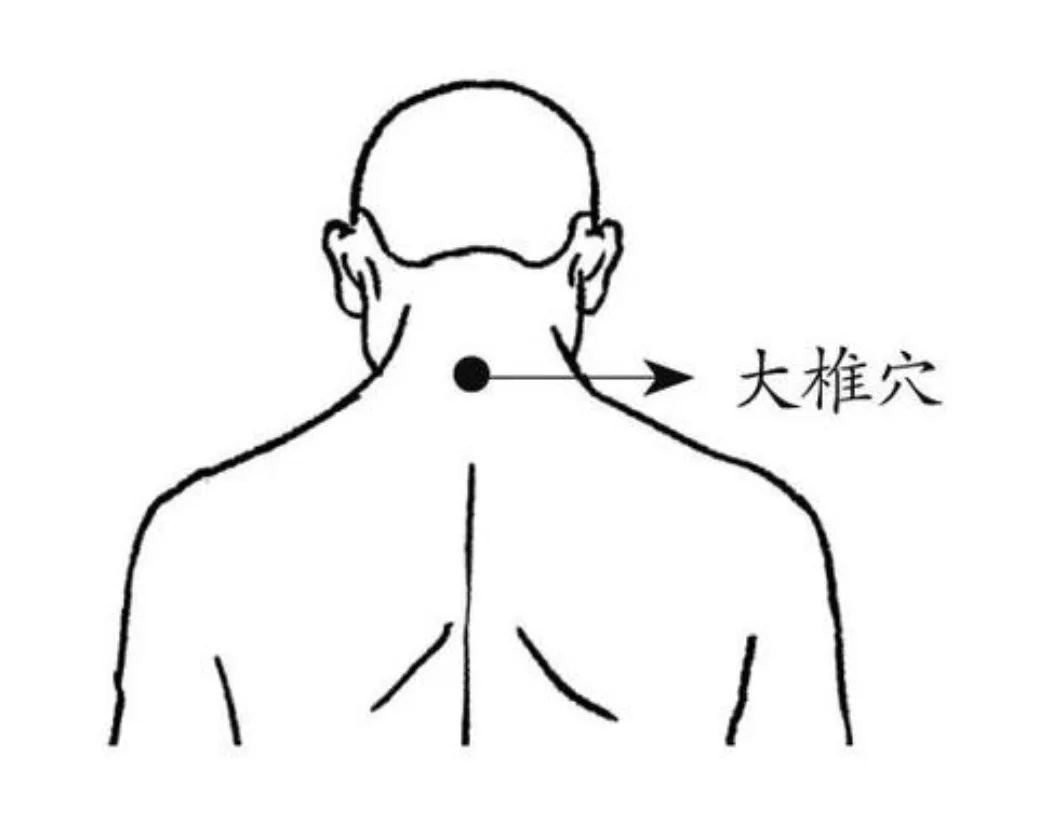
GV14 sits on the back of the neck, on the midline, in the hollow just below the spinous process of the seventh cervical vertebra (C7). To find it, lower your chin toward your chest and run a finger down the back of your neck — the first prominent bump that moves as you nod is C7, the seventh cervical vertebra. The soft hollow immediately below that bump is GV14. When you lift your head, the bump tucks away, which is why the point is easiest to feel with the chin lowered.
Three quick confirmations you have the right spot: (1) it is the soft hollow on the midline directly below the most prominent neck bump; (2) the bump above it moves when you nod your head; (3) pressing the hollow produces a deep, achy, slightly warm sensation — never a sharp pinch on the bone.
When to Use GV14 (and When Not)
Use it when
- • You feel the first scratchy, achy signs that a cold is coming on
- • You have chills, a fever, or that run-down "under the weather" feeling
- • Your neck is stiff where it meets the upper shoulders
- • You feel the cold easily and want a daily defense point in winter
Hold off if
- • You recently injured the neck or cervical spine, or had whiplash or neck surgery
- • There is broken skin, a rash, or tenderness over the back of the neck
- • A stiff neck comes with a fever and headache — that needs medical attention
- • You feel dizzy, nauseous, or the pressure causes numbness or tingling
Use the Hold off column as a safety filter: GV14 is a comfort practice for the early signs of a cold and ordinary neck stiffness, not first aid for a serious fever or a new neck injury.
What Are the Benefits?
- Fever and chills: GV14 is traditionally used at the start of a fever to help the body regulate temperature.
- Colds and flu: It is the classic "first sign of a cold" point, pressed early to support recovery.
- Headache: It may help ease headaches, especially ones that come with neck tension.
- Neck stiffness: It relieves a stiff, tight neck where it meets the upper shoulders.
- Immune support: As the meeting of the yang meridians, it is used to strengthen the body's defenses and combat feeling the cold.
How Do You Use This Point?
Lower your chin to expose the point, then work the hollow below the C7 bump with a fingertip or knuckle. The pressure should feel deep but comfortable, never sharp against the bone.
Step-by-step technique
- Lower your chin toward your chest to expose the C7 bump and the hollow below it.
- Place your middle fingertip or knuckle into the hollow just below the bump.
- Press and knead in a slow circular motion for 1–2 minutes.
- Gently tip your head back and forward a few times while pressing to work the area.
- Repeat 2–3 times a day at the first sign of a cold or when the neck feels stiff.
Common mistake to avoid: pressing on the bony bump itself or directly over the spine. The target is the soft hollow below and slightly beside the C7 bump — if you feel hard bone under your fingertip, shift down into the dip and stay there.
Combine GV14 with These Points
A full cold-season routine is more effective than pressing one point. Pick the row closest to your situation and work the points in the order shown, 30–60 seconds each.
| Goal / symptom | Routine (in order) |
|---|---|
| First signs of a cold | GV14 → LU7 → LI4, 30–60s each, up to 3 times on the first day |
| Fever or chills | GV14 → BL13 → LI4, then rest warm and hydrate |
| Headache with neck stiffness | GV14 → GB20 → LU7, holding each 60s for up to 3 minutes total |
| Feeling the cold / immunity maintenance | GV14 → BL13 → CV6 daily through cold season |
For a fuller program, see the back acupressure points body guide and our acupressure for neck pain page.
What to Expect
First session (today)
The point is often tender, and the neck may feel warm or looser within a few minutes. Some people notice an easing of chills or the heavy-headed feeling early in a cold. Do not expect a cure after one press.
Days 3–7 (consistent daily practice)
With 2–3 sessions per day at the first sign of a cold, many people feel the episode stays milder and the neck stays more flexible. This matches the pattern in studies of acupressure for pain and respiratory comfort, where benefits build over several days of regular use.
Weeks 2–4
For cold-season maintenance, keep GV14 as a daily ritual alongside sleep, warmth, and hydration. Acupressure is a support, not a treatment — if a fever is high and not settling, symptoms get worse, or a stiff neck comes with a severe headache, stop self-treatment and see a clinician.
What Does the Research Say?
Evidence on acupressure for respiratory and musculoskeletal conditions has grown in recent years. Systematic reviews and randomized controlled trials have examined acupressure as an adjunct for pain and immune-related complaints, with results that are generally promising but limited in quality. Points on the neck and upper back are common in studies of headache, neck pain, and immune support, and several trials report that pressure at these points may ease tension and discomfort, though the studies are small and methodologically varied.
Researchers consistently note that acupressure trials are hard to blind, because the treatment is physical and participants can usually tell whether they are being treated. This makes it difficult to separate the specific effects of a particular point from the general benefits of touch, pressure, and relaxation. The overall picture — which we discuss in detail on our does acupressure work? review — is one of encouraging signals alongside a clear need for larger, higher-quality studies before firm conclusions can be drawn. For colds and general wellbeing, acupressure is best understood as a low-risk comfort measure that supports, but never replaces, medical care.
Acupressure has been evaluated in clinical trials for pain, nausea, anxiety, and sleep, with evidence described as promising but requiring further high-quality research.
— Lee EJ, Frazier SK. Journal of Pain and Symptom Management. 2011;42(4):589-603. PMID 21531533.
Verifiable sources
- Lee EJ, Frazier SK. The efficacy of acupressure for symptom management: a systematic review. Journal of Pain and Symptom Management. 2011;42(4):589-603. PMID 21531533 · DOI
The review above evaluated acupressure for symptom management, including immune and fever-related complaints. It is not a study of GV14 in isolation.
Are There Safety Concerns?
- Avoid GV14 if you have a recent neck or spine injury, whiplash, or recent neck surgery.
- Do not press on the bony bump itself or over the top of the spine — work only the soft hollow beside and below it.
- Skip the point if there are skin irritations, rashes, or broken skin over the back of the neck.
- Stop if you feel dizzy, nauseous, or experience numbness or tingling.
- Seek medical care for a high fever, a stiff neck with a headache, or a fever in an infant.
Red Flags — See a Professional
Stop self-treatment and see a doctor if you notice any of the following:
- A high fever that does not settle, or a fever in an infant or young child
- A stiff neck together with a severe headache and fever — this can be serious
- Neck pain that appeared suddenly after a fall, twist, or whiplash
- Numbness, tingling, weakness, or pain running down the arms
- Cold symptoms that keep getting worse instead of improving after 1–2 weeks