LU1 (Zhongfu) — Central Mansion
LU1, known as Zhongfu or Central Mansion, is the Front-Mu point of the Lung meridian. Located on the upper chest, it is a go-to point for coughs, wheezing, chest tightness, and upper respiratory discomfort — including the shoulder and back tension that often comes with a lingering cough.
At a Glance
| Meridian | Lung (LU) |
|---|---|
| Body region | Upper chest, in the first rib space below the outer end of the collarbone |
| Best for | Cough, asthma and wheezing, chest tightness, upper respiratory congestion, shoulder and back tension |
| Difficulty | Easy to reach, but requires light pressure to protect the ribs |
| Hold time | 30–60 seconds per side |
| Frequency | 2–3 times daily |
| Pairs well with | LU7 (Lieque), CV22 (Tiantu), CV17 (Shanzhong) |
| Skip if | Recent rib injury or fracture, chest surgery, or broken skin over the point (see Precautions) |
Why LU1 Matters
LU1 is the Front-Mu (alarm) point of the Lung meridian, which means it is one of the places where the energy of the Lung channel gathers most directly on the front of the body. In traditional practice, Mu points are used both to diagnose and to treat their associated organ, so LU1 is the classic starting point for anyone working with cough, wheezing, or a feeling of tightness in the chest. It sits high on the chest wall, where the ribs and collarbone meet, which makes it easy to reach for self-care without any special tools.
Because the point lies near the shoulder and the upper back, it also helps locally when that area feels sore or heavy — many people with a lingering cough or seasonal congestion notice tension spreading up into the shoulder girdle, and LU1 addresses both the respiratory complaint and the local muscle tension. In traditional formulas it is often paired with LU7 and with the throat and chest points CV22 and CV17 for deeper, easier breathing, and it can be pressed any time of day, whether you are sitting at a desk or lying down before sleep. The one rule is to keep the pressure light: LU1 sits between the ribs, and pressing too firmly against the bone causes exactly the kind of chest tenderness you are trying to relieve.
Where Is This Point Located?
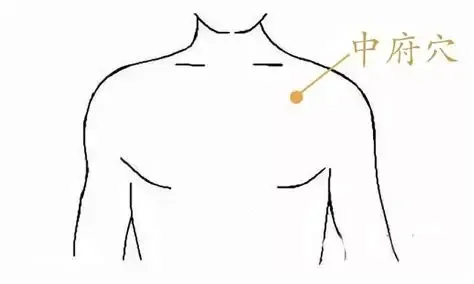
LU1 sits on the front of the chest, high on the chest wall, in the first intercostal space (the gap between the first and second ribs). It lies about six finger-widths (cun) from the midline of the body, just below and outside the lateral end of the collarbone. The simplest way to find it is to place your hand on your hip with the arm relaxed — the elbow drops and the upper arm settles, which opens the hollow just below the outer end of the collarbone. Drop one finger-width down from that hollow and you will feel the first rib space; the tender spot there is LU1.
Three quick confirmations you have the right spot: (1) the tender spot is in the soft space between the ribs, not on the collarbone itself; (2) pressing gently toward the midline of your body produces a deep, dull ache rather than a sharp pinch on bone; (3) it lines up with the hollow that opens when you place your hand on your hip.
When to Use LU1 (and When Not)
Use it when
- • You have a persistent or tickly cough that will not settle
- • Your chest feels tight, congested, or hard to breathe into fully
- • You want a daily maintenance point during cold and flu season
- • The upper chest, collarbone, or shoulder feels heavy after repeated coughing
Hold off if
- • You recently injured the ribs, chest, or collarbone, or had chest surgery
- • There is broken skin, a rash, or tenderness over the point itself
- • Pressing causes rib pain or any sharp, knifing sensation
- • You are having difficulty breathing, chest pain, or coughing up blood
Use the Hold off column as a safety filter: LU1 is a comfort practice for mild respiratory tension, not first aid for sudden chest or breathing problems.
What Are the Benefits?
- Cough: LU1 is traditionally used to soothe persistent coughs and tickly throats.
- Asthma and wheezing: It may help ease wheezing and support easier, fuller breathing.
- Chest tightness and pain: It is a classic point for a feeling of congestion or pressure across the chest.
- Shoulder and back discomfort: It relieves local tension around the upper chest, collarbone, and shoulder.
- Upper respiratory discomfort: It is used for stuffiness, nasal congestion, and the early symptoms of a cold.
For a complete step-by-step routine, see our anxiety acupressure guide.
How Do You Use This Point?
Lie on your back or sit up straight, relax the shoulders, and use two fingers together so the pressure spreads across the space between the ribs rather than digging into the bone. Gentle depth is correct here — LU1 is one of the few points where "less is more."
Step-by-step technique
- Sit or lie down and place one hand on your hip so the collarbone hollow opens up.
- Press your middle and index fingertips into the first rib space, just below the outer end of the collarbone.
- Direct the pressure gently toward the midline of your body, feeling the soft tissue between the ribs.
- Hold for 30–60 seconds with slow, even breathing, then release gradually.
- Repeat on the other side, and use 2–3 times a day when you feel congested.
Common mistake to avoid: pressing hard enough to feel the ribs digging back. The target sensation is a deep, dull, spreading ache in the intercostal space — if you feel a sharp pinch against bone or any rib tenderness afterward, ease off noticeably or skip the point.
Combine LU1 with These Points
A full respiratory routine is more effective than pressing one point. Pick the row closest to your situation and work the points in the order shown, 30–60 seconds each.
| Goal / symptom | Routine (in order) |
|---|---|
| Dry, tickly cough | LU1 → LU7 → CV22, 30–60s each, 2–3 times daily |
| Chest tightness or shallow breathing | LU1 → CV17 → CV22, then a few slow, full breaths with hands resting on the chest |
| Cold onset with congestion | LU1 → LI4 → LU7, holding each 60s for up to 3 minutes total |
| Upper chest and shoulder heaviness after coughing | LU1 → LU7 → GB20, then gentle shoulder rolls to finish |
For a fuller program, see the chest acupressure points body guide and our does acupressure work? research review.
What to Expect
First session (today)
The point is often noticeably tender, especially during a cough or cold. Most people feel a looser, more open sensation across the upper chest within a few minutes, though congestion can return as the day goes on. Do not expect a cure after one press.
Days 3–7 (consistent daily practice)
With 2–3 sessions per day, tenderness at the point usually eases and breathing often feels fuller and less effortful. This matches the pattern in studies of acupressure for respiratory symptoms, where benefits appear after several days of regular use.
Weeks 2–4
For chronic conditions such as asthma or a cough that lingers, keep LU1 as a complement to your medical care — it supports breathing and chest comfort but never replaces prescribed treatment. A cough that is not improving after 2–3 weeks, or any chest pain, is a signal to see a clinician.
What Does the Research Say?
Evidence on acupressure for respiratory and musculoskeletal conditions has grown in recent years. Systematic reviews and randomized controlled trials have examined acupressure as an adjunct for pain and breathing-related complaints, with results that are generally promising but limited in quality. Meta-analyses of acupressure tend to show a positive direction of effect, though many of the included studies are small and their methodological quality varies considerably.
Researchers consistently note that acupressure trials are hard to blind, because the treatment is physical and participants can usually tell whether they are being treated. This makes it difficult to separate the specific effects of a particular point from the general benefits of touch, pressure, and relaxation. The overall picture — which we discuss in detail on our does acupressure work? review — is one of encouraging signals alongside a clear need for larger, higher-quality studies before firm conclusions can be drawn. For respiratory care specifically, acupressure is best understood as a low-risk comfort measure that supports, but never replaces, medical treatment.
Acupressure has been evaluated in clinical trials for pain, nausea, anxiety, and sleep, with evidence described as promising but requiring further high-quality research.
— Song HJ, Seo HJ, Lee H, Son H, Choi SM, Lee S. Complementary Therapies in Medicine. 2015;23(1):68-78. PMID 25637155.
Verifiable sources
- Song HJ, Seo HJ, Lee H, Son H, Choi SM, Lee S. Effect of self-acupressure for symptom management: a systematic review. Complementary Therapies in Medicine. 2015;23(1):68-78. PMID 25637155 · DOI
The review above assessed self-acupressure across respiratory complaints. It is not a study of LU1 in isolation, but LU1 is the point most commonly used for lung support.
Are There Safety Concerns?
- Avoid LU1 if you have a recent chest injury, rib fracture, or surgery near the collarbone or breastbone.
- Do not press directly on the bone or breast tissue — keep the fingertips between the ribs and use gentle depth.
- Skip the point if there are skin irritations, rashes, or broken skin over the chest.
- Stop if pressing causes rib pain or a sharp sensation, and never press hard enough to worry the ribs.
- Seek medical care for severe or sudden chest symptoms, difficulty breathing, or coughing up blood rather than pressing.
Red Flags — See a Professional
Stop self-treatment and see a doctor if you notice any of the following:
- Sudden, severe, or crushing chest pain, pressure, or tightness
- Shortness of breath that gets worse, or difficulty catching your breath
- Coughing up blood, or a cough that lasts more than 3 weeks without improvement
- High fever, wheezing that does not settle, or signs of a serious respiratory infection
- Rib pain or tenderness that appears after a fall, twist, or heavy impact