LI15 (Jianyu) — Shoulder Bone Joint
LI15, known as Jianyu or Shoulder Bone Joint, is a Large Intestine meridian point at the front of the shoulder. It is one of the most commonly used shoulder points, traditionally employed for shoulder pain, frozen shoulder, and weakness or numbness in the upper arm.
At a Glance
| Meridian | Large Intestine (LI) |
|---|---|
| Body region | Front of the shoulder, in the hollow below the acromion |
| Best for | Shoulder pain, frozen shoulder, upper-arm weakness and numbness |
| Difficulty | Easy to reach yourself from the opposite side |
| Hold time | 30–60 seconds per side |
| Frequency | 1–3 times daily |
| Pairs well with | SI9 (Jianzhen), GB21 (Jianjing) |
| Skip if | Recent shoulder injury, dislocation, surgery, or acute inflammation (see Precautions) |
Why LI15 Matters
LI15 is the Large Intestine meridian's primary shoulder point and one of the most frequently used points in the whole body for shoulder complaints. It sits in the depression just below and in front of the acromion — the bony tip of the shoulder — which places it directly over the structures involved when the shoulder hurts with lifting, reaching, or overhead movement. Its central position makes it a first-choice point for both local shoulder pain and the restricted motion of frozen shoulder.
Because the Large Intestine meridian runs from the index finger up the arm to the face, LI15 is also classically linked to arm problems lower down the limb, including weakness, numbness, and the discomfort of tennis elbow. For shoulder pain, LI15 is almost always used together with points at the back and top of the shoulder — most commonly SI9 and GB21 — so that the entire joint is addressed from every angle rather than treated as a single tender spot.
Where Is This Point Located?
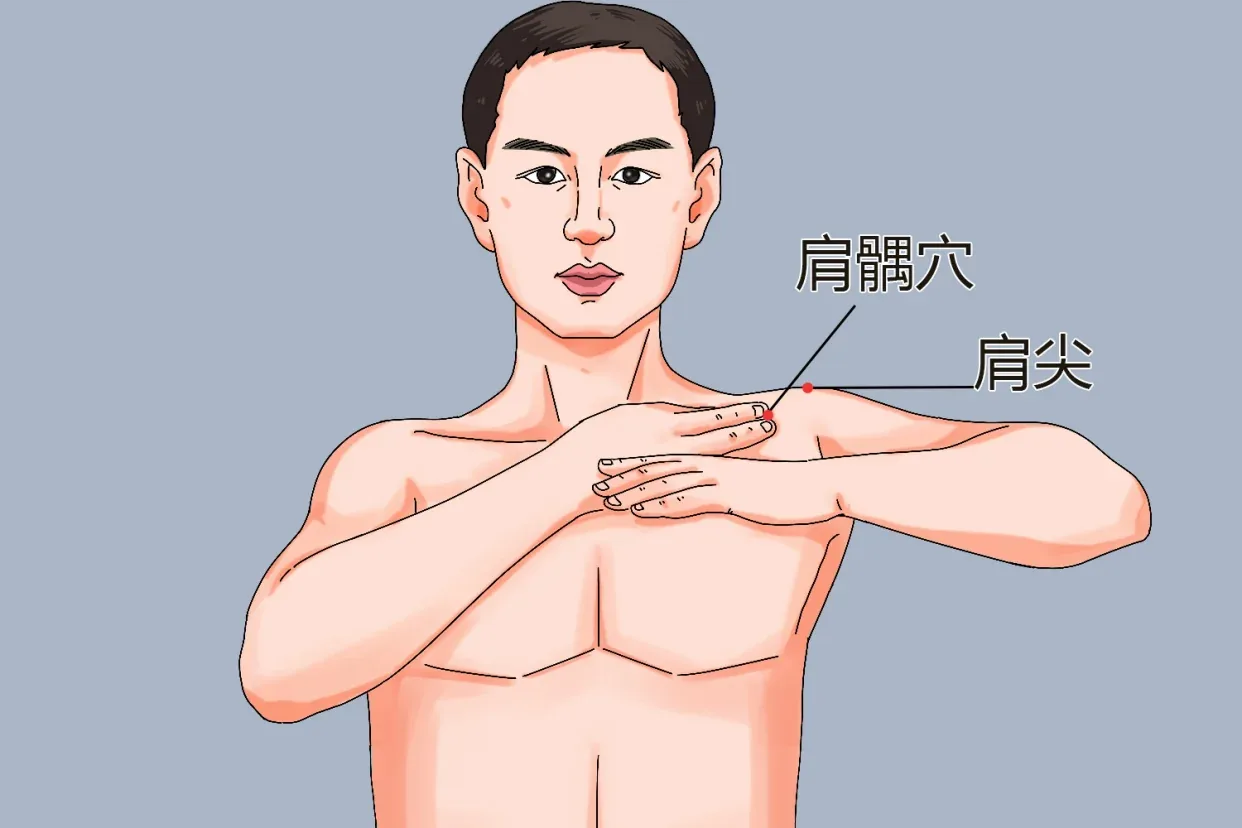
LI15 lies in the depression below and slightly in front of the acromion process. The easiest way to find it is to raise your arm out to the side: two hollows appear below the bony point of the shoulder, and LI15 is the front one of the two, in line with the top of the arm. When the arm hangs relaxed, it sits just anterior to the deltoid, directly above the shoulder joint.
Three quick confirmations you have the right spot: (1) the hollow you press is the front one of the two that appear when you abduct the arm; (2) pressing toward the joint produces a deep, dull ache rather than a sharp pinch; (3) the tenderness usually matches where your shoulder feels stiff or painful when reaching.
When to Use LI15 (and When Not)
Use it when
- • You feel pain at the front or top of the shoulder with reaching or lifting
- • Raising the arm overhead hurts or feels limited
- • The shoulder feels stiff after desk work, hunching, or repetitive arm use
- • The upper arm feels weak, heavy, or numb
Hold off if
- • You recently dislocated the shoulder, fractured the bone, or had shoulder surgery
- • The shoulder is hot, swollen, or acutely inflamed
- • There is bruising, a rash, or broken skin over the point
- • You cannot move the arm at all, or pain follows a sudden injury
Use the Hold off column as a safety filter: LI15 is a comfort practice for chronic tightness and recovery, not first aid for an acute shoulder injury.
What Are the Benefits?
- Shoulder pain: LI15 helps relieve pain at the front and top of the shoulder, including pain with reaching or lifting.
- Frozen shoulder: It is a first-choice point for stiffness and reduced range of motion in the joint.
- Upper arm weakness: LI15 is traditionally used for weakness, heaviness, or numbness in the arm.
- Arm paralysis: In clinical tradition it appears in treatment of paralysis or loss of sensation in the upper limb.
- Tennis elbow: As the shoulder anchor of the arm points, LI15 supports relief for elbow-related upper limb strain.
How Do You Use This Point?
The point can sit fairly deep, so use a firm thumb and press slowly until you feel a dull, achy sensation, then keep the pressure steady while gently moving the arm.
Step-by-step technique
- Raise your arm slightly out to the side so the hollows under the shoulder bone open up.
- Place your opposite thumb on the front hollow, just below and ahead of the acromion.
- Press in with a slow, circular motion, deepening until you feel a dull ache.
- Hold for 30–60 seconds while slowly raising and lowering the arm.
- Release gradually, repeat on the other side, and work through this 1–3 times daily.
Common mistake to avoid: pressing on the bony acromion itself or digging in so hard that you feel a sharp pinch. The target sensation is a deep, dull, spreading ache — ease off a notch if it feels sharp or you cannot breathe steadily.
Combine LI15 with These Points
A full-shoulder routine is more effective than pressing one point. Pick the row closest to your situation and work the points in the order shown, 30–60 seconds each.
| Goal / symptom | Routine (in order) |
|---|---|
| General shoulder stiffness | LI15 → SI9 → GB21, 30–60s each, repeat 1–2 times daily |
| Frozen shoulder recovery | LI15 → GB21 → SI9, then gentle arm circles; daily as part of physical therapy |
| Upper-arm weakness or numbness | LI15 → LI11 → LI4, holding each 60s |
| Desk/hunch tightness (prevention) | LI15 + GB21 at midday and again before bed; pair with posture breaks every 30–45 minutes |
For a fuller program, see the shoulder acupressure points body guide and our acupressure for neck pain page.
What to Expect
First session (today)
LI15 may feel notably tender, and you may notice a looser, "released" feeling in the front of the shoulder within a few minutes. Any stiffness can return as the day goes on, so treat the first session as a test run, not a fix.
Days 3–7 (consistent daily practice)
With 1–2 sessions per day, tenderness at the point usually eases and reaching or lifting often feels smoother. This matches the pattern in studies of acupressure for shoulder pain, where benefits appear after several days of regular use.
Weeks 2–4
For chronic conditions such as frozen shoulder, combine LI15 with your physiotherapy plan. Acupressure is a complement, not a replacement — it supports range-of-motion work and should never be used to push through sharp pain. Plateau or no change after 2–3 weeks is a signal to see a clinician.
What Does the Research Say?
Evidence on acupressure for shoulder and musculoskeletal pain has grown in recent years. Systematic reviews and randomized controlled trials have examined acupressure as an adjunct for pain conditions, with results that are generally promising but limited in quality. Meta-analyses of acupressure for pain tend to show a positive direction of effect, though many of the included studies are small and their methodological quality varies considerably.
Researchers consistently note that acupressure trials are hard to blind, because the treatment is physical and participants can usually tell whether they are being treated. This makes it difficult to separate the specific effects of a particular point from the general benefits of touch, pressure, and relaxation. The overall picture — which we discuss in detail on our does acupressure work? review — is one of encouraging signals alongside a clear need for larger, higher-quality studies before firm conclusions can be drawn. For shoulder pain specifically, the shoulder acupressure points guide summarizes the strongest available evidence.
Acupressure has been evaluated in clinical trials for pain, nausea, anxiety, and sleep, with evidence described as promising but requiring further high-quality research.
— Chen YW, Wang HH. Pain Management Nursing. 2014;15(2):539-550. PMID 23415783.
Verifiable sources
- Chen YW, Wang HH. The effectiveness of acupressure on relieving pain: a systematic review. Pain Management Nursing. 2014;15(2):539-550. PMID 23415783 · DOI
The review above evaluated acupressure for pain, including shoulder complaints. It is not a study of LI15 in isolation.
Are There Safety Concerns?
- Avoid if you have a recent shoulder injury, dislocation, fracture, or shoulder surgery.
- Do not press over the point if there are skin lesions, bruising, or swelling on the shoulder.
- Use lighter pressure if the shoulder is acutely inflamed or after a recent injection.
- Stop if pressure worsens pain or causes numbness or tingling down the arm.
Red Flags — See a Professional
Stop self-treatment and see a doctor or physiotherapist if you notice any of the following:
- Shoulder pain that appeared suddenly after a fall, twist, or heavy lift
- An inability to lift your arm at all, or severe weakness
- Numbness, tingling, or a "pins and needles" feeling running down the arm or into the hand
- Visible swelling, redness, heat, or fever with the shoulder pain
- Pain that has not improved after 2–3 weeks of regular acupressure and gentle movement