LI11 (Quchi) — Pool at the Crook
LI11, known as Quchi or Pool at the Crook, is a key point for clearing heat, treating allergies, skin conditions, and supporting immune function. Located at the outer end of the elbow crease, it also relieves local elbow and arm strain.
At a Glance
| Meridian | Large Intestine (LI) |
|---|---|
| Body region | Outer end of the elbow crease, in the depression that forms when the elbow is bent |
| Best for | Allergies, skin conditions (eczema, acne), immune support, fever, tennis elbow and arm strain |
| Difficulty | Easy — exposed when the elbow is bent |
| Hold time | 30–60 seconds per arm |
| Frequency | 2–3 times daily during allergy season |
| Pairs well with | LI4 (Hegu), SP6 (Sanyinjiao), GB20 (Fengchi) |
| Skip if | A recent elbow injury, fracture, or surgery, or broken skin, burns, or rashes over the elbow |
Why LI11 Matters
LI11 is one of the Large Intestine meridian's most-used points, and its position at the outer end of the elbow crease makes it easy to reach for self-care. It is the site's key point for clearing heat, listed for allergies, skin health, and immunity. Because the Large Intestine meridian runs from the fingertips toward the face, LI11 is classically linked to conditions in the head and upper body, such as sinus congestion, allergic rhinitis, and hives.
The same band of arm points also provides local relief in the limb, and LI11 is commonly used for tennis elbow, elbow stiffness, and arm fatigue. In allergy season it pairs with LI4 for immune support, and for skin conditions it combines with SP6 to cool blood and clear heat — sustained pressure at the elbow is felt clearly and quickly.
Where Is This Point Located?
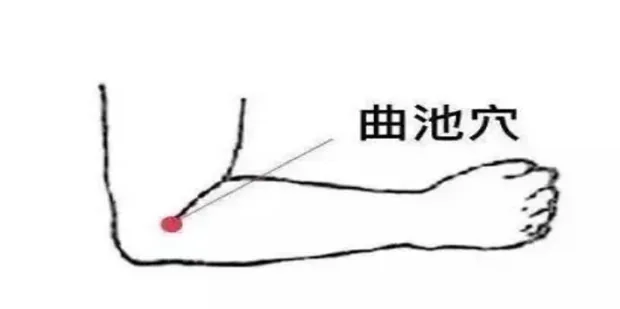
LI11 is at the outer end of the elbow crease, in the depression that forms when the elbow is bent. It lies midway between the lateral epicondyle of the humerus and the elbow crease.
Three quick confirmations you have the right spot: (1) it sits at the outer end of the crease, not at the center of the elbow; (2) the depression deepens when you bend the elbow; (3) firm pressure yields a deep, dull ache — a sharp jolt into the forearm means you are off the point.
When to Use LI11 (and When Not)
Use it when
- • Hay fever or allergic rhinitis season has your sinuses and eyes irritated
- • Eczema, acne, or hives are flaring up
- • You feel run down and want an immune-maintenance point
- • You have tennis elbow, elbow stiffness, or arm fatigue from repetitive use
Hold off if
- • You recently injured the elbow, fractured it, or had elbow surgery
- • There are skin lesions, burns, or rashes over the point
- • Pressure causes numbness or tingling running down the forearm
- • You have a high fever — that should be evaluated by a doctor, not self-treated
Use the Hold off column as a safety filter: LI11 is a daily wellness point for allergies, skin, and immunity — not first aid for an acute elbow injury or a high fever.
What Are the Benefits?
- Allergies: LI11 helps relieve hay fever, allergic rhinitis, sinus congestion, and hives.
- Skin health: It is used for eczema, psoriasis, acne, and other inflammatory skin conditions.
- Immune support: LI11 strengthens the immune system and helps the body fight infections.
- Fever and inflammation: In the traditional model it clears heat from the body and supports recovery from fever.
- Elbow and arm pain: LI11 can relieve tennis elbow, elbow stiffness, and arm fatigue.
How Do You Use This Point?
Rest the arm on a stable surface, press at a 90-degree angle, and deepen the pressure gradually until you feel a deep, dull ache. Keep the pressure steady rather than squeezing.
Step-by-step technique
- Bend your elbow to expose the outer elbow crease.
- Place your opposite thumb on the LI11 point at the end of the crease.
- Apply firm pressure with a small circular or pumping motion.
- Hold for 30–60 seconds, then switch arms.
- Repeat 2–3 times daily during allergy season.
Common mistake to avoid: squeezing the elbow instead of pressing at a right angle, or digging into fresh skin lesions. Rest the arm, press perpendicular to the skin, deepen slowly, and skip the point entirely if the skin over it is broken.
Combine LI11 with These Points
An allergy or immune routine is more effective than pressing one point. Pick the row closest to your situation and work the points in the order shown, 30–60 seconds each.
| Goal / symptom | Routine (in order) |
|---|---|
| Seasonal allergies / hay fever | LI4 → LI11 → GB20, 2–3 times daily in season |
| Skin flare (eczema / acne) | LI11 → SP6 → LI4, 1–2 min each, once or twice daily |
| Immune support / cold season | LI11 → LI4 → ST36, once daily as a maintenance routine |
| Tennis elbow / arm strain | LI11 → LI4 → PC6, 60s each, paired with rest of the arm |
For more on the points in this area, see the arm & wrist acupressure points body guide and the hand acupressure chart.
What to Expect
First session (today)
LI11 is often noticeably tender, and most people feel a warm, releasing sensation in the elbow within a minute of sustained pressure. Do not expect allergy or skin symptoms to change after one session — this is a daily-consistency point.
Days 3–7 (consistent daily practice)
With 2–3 sessions per day during allergy season, sinus stuffiness and skin flares often ease. This matches the pattern in studies of acupressure for allergic rhinitis and inflammatory skin conditions, where benefits appear after several days of regular use.
Weeks 2–4
For chronic skin conditions or persistent elbow pain, pair LI11 with SP6 and rest of the arm, and see a dermatologist or doctor for skin that is spreading, oozing, or not improving. Acupressure is a complement, not a replacement — severe allergic reactions need emergency care.
What Does the Research Say?
Evidence on acupressure for allergies and skin conditions has grown in recent years. Systematic reviews and randomized controlled trials have examined acupressure and acupuncture as adjuncts for allergic rhinitis and inflammatory skin conditions, with results that are generally promising but limited in quality. LI11 and LI4, as two of the most-studied Large Intestine points, appear frequently in these protocols — often in studies of allergy and immunity outcomes.
Researchers consistently note that acupressure trials are hard to blind, because the treatment is physical and participants can usually tell whether they are being treated. This makes it difficult to separate the specific effects of a particular point from the general benefits of touch, pressure, and relaxation. The overall picture — which we discuss in detail on our does acupressure work? review — is one of encouraging signals alongside a clear need for larger, higher-quality studies before firm conclusions can be drawn.
Acupressure has been evaluated in clinical trials for pain, nausea, anxiety, and sleep, with evidence described as promising but requiring further high-quality research.
— Chen YW, Wang HH. Pain Management Nursing. 2014;15(2):539-550. PMID 23415783.
Verifiable sources
- Chen YW, Wang HH. The effectiveness of acupressure on relieving pain: a systematic review. Pain Management Nursing. 2014;15(2):539-550. PMID 23415783 · DOI
- Lee EJ, Frazier SK. The efficacy of acupressure for symptom management: a systematic review. Journal of Pain and Symptom Management. 2011;42(4):589-603. PMID 21531533 · DOI
The reviews above evaluated acupressure for pain and for symptom management. Neither is a study of LI11 in isolation, but LI11 is among the most frequently used points in these trials.
Are There Safety Concerns?
- Avoid if you have a recent elbow injury, fracture, or surgery.
- Do not apply pressure over skin lesions, burns, or rashes at the elbow.
- Use gentle pressure on the elderly or those with fragile skin around the elbow.
- Stop if pressure causes numbness or tingling radiating down the forearm.
- A high fever, or skin that is spreading, oozing, or accompanied by fever, should be evaluated by a doctor.
Red Flags — See a Professional
Stop self-treatment and see a doctor or dermatologist if you notice any of the following:
- Difficulty breathing, swelling of the face or throat, or a rapidly spreading rash — this needs emergency care
- Skin lesions that are oozing, crusting, or accompanied by fever
- A rapidly spreading or painful skin infection
- Elbow pain after a significant fall or injury, or an elbow that cannot move
- Skin or allergy symptoms that have not improved after 2–3 weeks of regular acupressure
Frequently Asked Questions
How do I find LI11 on myself?
How long and how often should I press LI11?
Can I press LI11 at work or while traveling?
Can LI11 help with elbow and arm pain?
When should I see a doctor instead of using LI11?
Related guides: acupressure for weight loss.