GB34 (Yanglingquan) — Yang Mound Spring
GB34, known as Yanglingquan or Yang Mound Spring, is a Gallbladder meridian point on the outer leg. As the meeting point of the tendons, it is traditionally used for leg pain, knee problems, sciatica, muscle stiffness, and shoulder pain.
At a Glance
| Meridian | Gallbladder (GB) |
|---|---|
| Body region | Outer lower leg, in the hollow below and in front of the fibular head |
| Best for | Muscle and tendon pain, sciatica, knee pain, shoulder pain |
| Difficulty | Easy to locate once you find the fibular head on the outside of the knee |
| Hold time | 30–60 seconds per side |
| Frequency | 1–3 times daily |
| Pairs well with | BL40 (Weizhong), BL60 (Kunlun), ST36 (Zusanli) |
| Skip if | Recent knee injury or a fracture near the fibular head (see Precautions) |
Why GB34 Matters
GB34 sits on the Gallbladder meridian, which runs down the outside of the leg, and it holds a special status in Chinese medicine as the meeting point of the tendons — a category that includes muscles, ligaments, and tendons throughout the body. This is why the phrase "jin hui yangling" (the tendon meeting point is Yanglingquan) appears in classical texts, and why GB34 is considered a master point for any complaint of stiffness, spasm, or discomfort involving the soft tissues that move the joints.
Its position in the depression just below the head of the fibula places it directly over structures involved in knee and lower leg mechanics, and it is among the most commonly used points for sciatica, leg pain, and knee pain. Because of its tendon-meeting status, GB34 is also traditionally selected for shoulder problems and for general muscle tension, even when the symptoms are far from the leg itself — a pattern that makes it one of the more versatile points to know.
Where Is This Point Located?
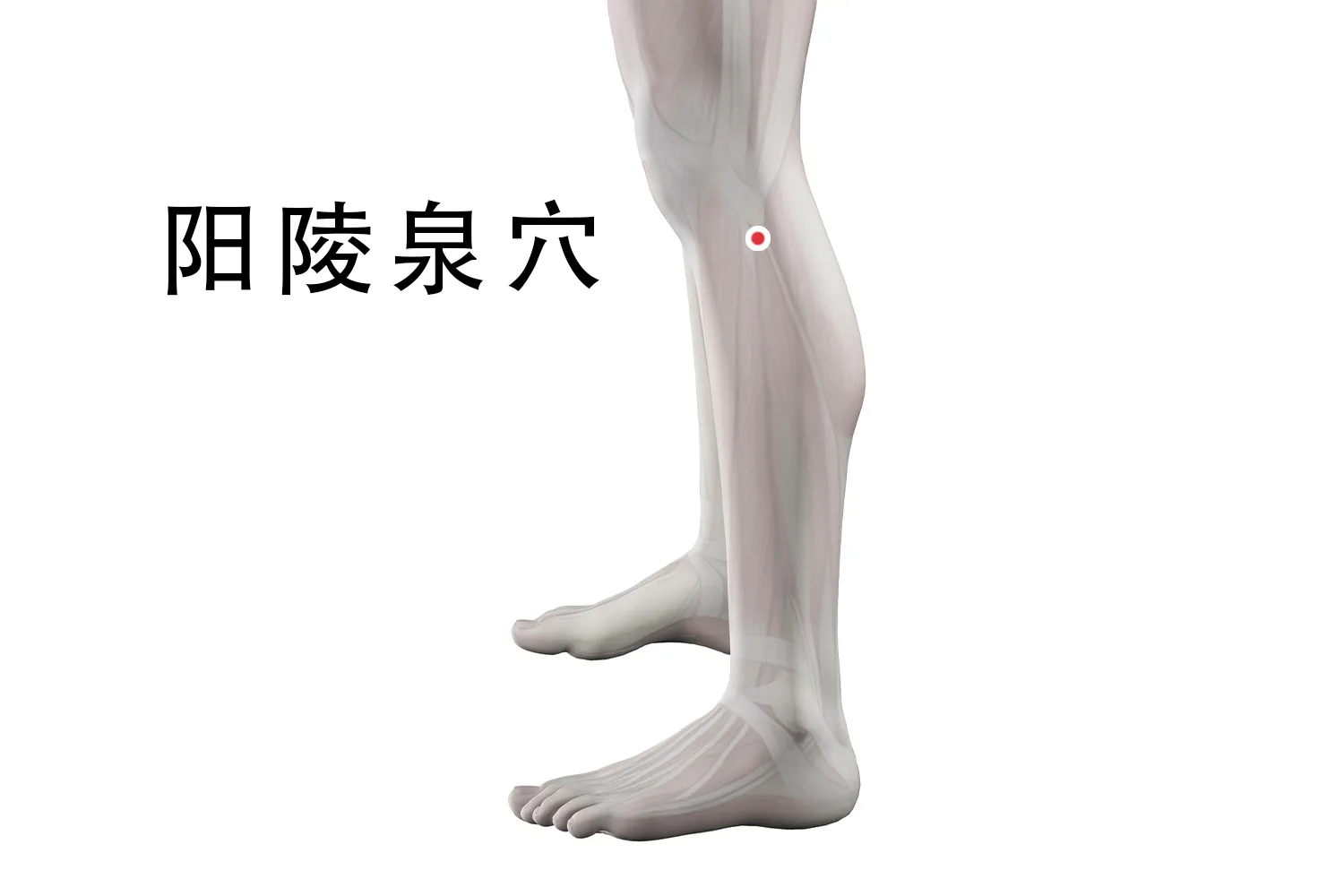
GB34 is on the outer side of the lower leg, in the depression just below and in front of the head of the fibula — the small, rounded bone that sticks out on the outside of the knee. Bend the knee slightly, slide a finger from the fibular head straight down into the hollow below and in front of it, and press; the point is usually distinctly tender there.
Three quick confirmations you have the right spot: (1) bend the knee — the fibular head is the small rounded bone on the outside of the knee, and the point is in the hollow just below and in front of it, not on the bone itself; (2) pressing it produces a pronounced sour, distending sensation that may travel down the outer shin; (3) the spot is usually more tender than the surrounding leg, so tenderness confirms the location.
When to Use GB34 (and When Not)
Use it when
- • You have pain along the outside of the leg or calf
- • Your knee feels stiff or uncomfortable around the joint
- • You have muscle cramps, spasms, or tight tendons anywhere in the body
- • Sciatic-region discomfort radiates down the leg, or your shoulder feels stiff
Hold off if
- • You recently injured the knee or had knee surgery near the fibular head
- • There is swelling, bruising, or broken skin over the point
- • Pressure triggers sharp electric pain or numbness down the shin
- • You cannot bear weight on the leg
Use the Hold off column as a safety filter: GB34 is a comfort practice for muscle and tendon tension, not first aid for an acute knee injury.
What Are the Benefits?
- Leg pain: GB34 helps relieve pain along the outside of the leg and calf.
- Sciatica: It is a traditional key point for pain radiating down the leg along the sciatic nerve pathway.
- Knee pain: GB34 supports relief for knee discomfort and stiffness around the joint.
- Muscle and tendon issues: As the tendon meeting point, GB34 is used for cramps, spasms, and tight muscles or tendons anywhere in the body.
- Shoulder pain: Because of its tendon-meeting status, GB34 is traditionally selected for shoulder stiffness and restricted movement too.
For a complete step-by-step routine, see our back pain acupressure guide.
How Do You Use This Point?
Press straight down into the hollow below the fibular head with your thumb — most people feel a pronounced sourness or distension here, which is the classic "deqi" sensation.
Step-by-step technique
- Sit with the knee bent and the leg relaxed.
- Locate the head of the fibula on the outside of the knee.
- Place your thumb in the depression just below and in front of it.
- Press down firmly with a slow, circular motion for 30–60 seconds.
- Switch legs and repeat, 1–3 times daily.
Common mistake to avoid: pressing directly on the fibular head bone instead of the hollow below it, or pressing so hard that you feel a sharp nerve twinge down the shin. The target sensation is a deep, sour, spreading ache — ease off if it turns electric or sharp.
Combine GB34 with These Points
A full leg routine is more effective than pressing one point. Pick the row closest to your situation and work the points in the order shown, 30–60 seconds each.
| Goal / symptom | Routine (in order) |
|---|---|
| Sciatica / leg pain down the back of the leg | GB34 → BL40 → BL60, 30–60s each, repeat 1–2 times daily |
| Knee pain and stiffness | GB34 → ST36, then gentle knee bends |
| Muscle cramps and tendon tightness | GB34 → BL40 → ST36, holding each 60s for up to 3 minutes total |
| Shoulder and general muscle tension | GB34 → GB20, 30–60s each, as part of a daily tension routine |
For a fuller program, see the leg acupressure points body guide. If your leg pain starts in the lower back, work BL40 (Weizhong) and BL60 (Kunlun) first.
What to Expect
First session (today)
GB34 is usually noticeably sore, and pressing it produces a deep, sour sensation. Many people feel the outer leg loosen within a few minutes, though any stiffness can return as the day goes on. Do not expect a cure after one press.
Days 3–7 (consistent daily practice)
With 1–2 sessions per day, tenderness at the point usually eases and the knee and calf often feel less stiff. This matches the pattern in studies of acupressure for musculoskeletal pain, where benefits appear after several days of regular use.
Weeks 2–4
For sciatica or chronic muscle tension, combine GB34 with movement and stretching — acupressure is a complement, not a replacement. Pain that does not improve after 2–3 weeks, or that comes with weakness or numbness, needs a clinician.
What Does the Research Say?
Leg, knee, and back complaints are common in the acupressure research literature. Systematic reviews and randomized controlled trials have examined acupressure as an adjunct for pain conditions, with results that are generally promising but limited in quality. Meta-analyses of acupressure for musculoskeletal pain tend to show a positive direction of effect, though study samples are often small and methodological quality across the field is inconsistent.
Like other manual therapies, acupressure is hard to blind in trials, so the specific contribution of a point such as GB34 is difficult to separate from the general effects of touch, pressure, and expectation. The evidence base is encouraging but not definitive — we lay out what is known, and what is still missing, in our does acupressure work? review.
Acupressure has been evaluated in clinical trials for pain, nausea, anxiety, and sleep, with evidence described as promising but requiring further high-quality research.
— Chen YW, Wang HH. Pain Management Nursing. 2014;15(2):539-550. PMID 23415783.
Verifiable sources
- Chen YW, Wang HH. The effectiveness of acupressure on relieving pain: a systematic review. Pain Management Nursing. 2014;15(2):539-550. PMID 23415783 · DOI
The review above evaluated acupressure for pain, including the knee and leg complaints this point is most used for. It is not a study of GB34 in isolation.
Are There Safety Concerns?
- Avoid if you have a recent knee injury, fracture, or knee surgery near the fibular head.
- Do not press if there are skin lesions, bruising, or swelling directly over the point.
- Use light pressure during pregnancy, as some limb points are traditionally treated with caution in pregnancy.
- Stop if pressure causes sharp nerve pain, numbness, or tingling radiating down the shin.
Red Flags — See a Professional
Stop self-treatment and see a doctor if you notice any of the following:
- Leg pain that appeared suddenly after a fall or twist, or a leg you cannot bear weight on
- Sudden swelling, warmth, or redness in the calf (possible blood clot — do not massage)
- Back or leg pain with numbness or weakness, or loss of bowel or bladder control
- Numbness or tingling that is getting worse
- Pain that has not improved after 2–3 weeks of regular care