BL60 (Kunlun) — Kunlun Mountains
BL60, known as Kunlun or Kunlun Mountains, sits in the groove behind the outer ankle. It is a primary stop for lower back pain, neck pain, headaches, ankle pain, and the kind of leg discomfort that travels along the sciatic nerve.
At a Glance
| Meridian | Bladder (BL) |
|---|---|
| Body region | Outer ankle, in the depression between the ankle bone and the Achilles tendon |
| Best for | Lower back pain, neck pain, headaches, ankle pain, sciatic-type leg discomfort |
| Difficulty | Easy to reach with your thumb while seated |
| Hold time | 30–60 seconds per side, up to 1–2 minutes |
| Frequency | 1–2 times daily |
| Pairs well with | BL40 (Weizhong), LI4 (Hegu), and GB34 (Yanglingquan) |
| Skip if | Pregnant (traditional contraindicated point) or recent outer-ankle injury (see Precautions) |
Why BL60 Matters
BL60 sits in the groove beside the outer ankle and appears again and again across our body-region guides. The Bladder meridian runs the full length of the back and down the leg, which is why a point at the ankle can be relevant for lower back pain, neck pain, and even headaches — and why BL60 is a common stop in foot and leg routines for sciatica-type discomfort.
The point's name, Kunlun Mountains, references the great western mountain range of Chinese geography, a fitting name for a point classically considered to support the strength of the back and legs. Traditionally, BL60 is also a contraindicated point during pregnancy — it is used to promote labor and ease delivery, so anyone who is pregnant should avoid it. For everyone else, it is one of the most practical "the whole back chain is sore" points on the body.
Where Is This Point Located?
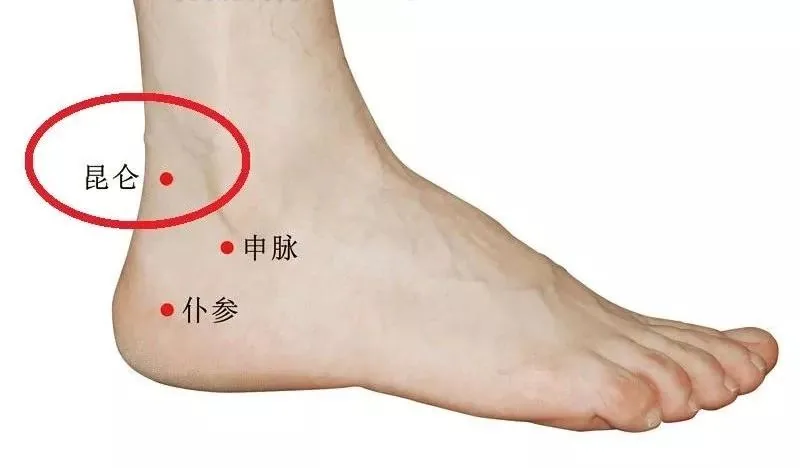
BL60 is in the depression between the lateral malleolus (outer ankle bone) and the Achilles tendon, level with the top of the ankle bone, on the Bladder meridian. Sit with the leg crossed and slide a finger into the groove between the ankle bone and the Achilles tendon — the tender hollow level with the top of the ankle bone is the point.
Three quick confirmations you have the right spot: (1) it is the soft depression centered between the outer ankle bone and the Achilles tendon, level with the top of the bone; (2) it is distinctly tender compared with the surrounding skin; (3) pressing it produces a deep, achy sensation that may feel like it spreads up the calf or down the foot — not a sharp pinch on the bone or tendon.
When to Use BL60 (and When Not)
Use it when
- • Your lower back aches after standing, sitting, or lifting
- • Neck and shoulder tension radiates toward the head or arm
- • You have sciatic-type discomfort running down the leg
- • The outer ankle or Achilles area is stiff or sore after activity
Hold off if
- • You are pregnant — BL60 is a traditional contraindicated point
- • You recently sprained or injured the outer ankle
- • The skin over the point is broken, cut, or has a rash
- • You have severe varicose veins or a history of deep vein thrombosis in the leg
Use the Hold off column as a safety filter: BL60 is a comfort practice for chronic back and leg tension, not first aid for an acute ankle injury — and never use it during pregnancy.
What Are the Benefits?
- Lower back pain: BL60 relieves pain along the Bladder meridian, a common point for lumbar aches.
- Neck pain: It supports neck and shoulder tension, especially when it refers toward the head.
- Headaches: BL60 is a traditional point for occipital headaches that start at the back of the head and neck.
- Sciatic-type discomfort: It follows the same line of travel as the sciatic nerve and is used for radiating leg pain.
- Ankle and Achilles support: BL60 helps with stiffness and soreness around the outer ankle and Achilles tendon after activity.
How Do You Use This Point?
Press firmly into the hollow behind the outer ankle, holding for 30–60 seconds per side and up to one to two minutes per leg. Because the point sits near the ankle bone, ease off rather than pressing into the ridge; increase pressure slowly to a deep, dull ache.
Step-by-step technique
- Sit with your leg crossed so your ankle is accessible.
- Place your thumb on the BL60 point behind your outer ankle.
- Apply firm, steady pressure with a circular or slow pushing motion.
- Hold for 30–60 seconds, breathing slowly, then repeat on the other leg.
- Finish with gentle ankle rotations to keep the joint moving.
Common mistake to avoid: pressing directly into the ankle bone or the Achilles tendon instead of the soft hollow between them. The target is a deep, dull, spreading ache in the depression — if you feel a sharp pinch on bone or a zing down the foot, reposition and ease off.
Combine BL60 with These Points
The Bladder meridian runs the whole back, so BL60 works best with a routine. Pick the row closest to your situation and work the points in the order shown, 30–60 seconds each.
| Goal / symptom | Routine (in order) |
|---|---|
| Lower back pain | BL60 → BL40 → BL23 (Shenshu), 60s each, 1–2 times daily |
| Sciatic-type leg discomfort | BL40 → BL60 → GB20, holding each 60s, with gentle hip and leg movement |
| Occipital headache from neck tension | GB20 → BL60 → LI4, 60s each, in a quiet space |
| Ankle stiffness after activity | BL60 → SP6, 60s each, followed by slow ankle circles both ways |
For a fuller program, see the acupressure for back pain and acupressure for neck pain pages, and the foot acupressure points body guide.
What to Expect
First session (today)
BL60 is usually markedly tender. Many people feel a release in the back and legs within a few minutes of firm pressure, though the effect can fade as the day goes on. Do not expect a chronic back to clear after one press — the first session is about learning the spot.
Days 3–7 (consistent daily practice)
With 1–2 sessions per day, tenderness at the point usually eases and back and leg tension often feels less intense. This matches the pattern in studies of acupressure for musculoskeletal pain, where benefits tend to appear after several days of regular use.
Weeks 2–4
For chronic back or sciatic-type pain, BL60 works best alongside movement, posture work, and, ideally, physiotherapy. Acupressure is a complement, not a replacement. Pain that is not improving after 2–3 weeks — or radiating pain with numbness or weakness — is a signal to see a clinician.
What Does the Research Say?
Evidence on acupressure for back, neck, and musculoskeletal pain has grown in recent years. Systematic reviews and randomized controlled trials have examined acupressure as an adjunct for pain conditions, with results that are generally promising but limited in quality. Meta-analyses of acupressure for pain tend to show a positive direction of effect, though many of the included studies are small and their methodological quality varies considerably.
Researchers consistently note that acupressure trials are hard to blind, because the treatment is physical and participants can usually tell whether they are being treated. This makes it difficult to separate the specific effects of a particular point such as BL60 from the general benefits of touch, pressure, and relaxation. The overall picture — which we discuss in detail on our does acupressure work? review — is one of encouraging signals alongside a clear need for larger, higher-quality studies before firm conclusions can be drawn. For back and neck pain specifically, our acupressure for back pain and acupressure for neck pain pages summarize the strongest available evidence.
Acupressure has been evaluated in clinical trials for pain, nausea, anxiety, and sleep, with evidence described as promising but requiring further high-quality research.
— Chen YW, Wang HH. Pain Management Nursing. 2014;15(2):539-550. PMID 23415783.
Verifiable sources
- Chen YW, Wang HH. The effectiveness of acupressure on relieving pain: a systematic review. Pain Management Nursing. 2014;15(2):539-550. PMID 23415783 · DOI
- Hsieh LL, Liou HH, Lee LH, Chen TH, Yen AM. Effect of acupressure and trigger points in treating headache: a randomized controlled trial. American Journal of Chinese Medicine. 2010;38(1):1-14. PMID 20128040 · DOI
These reviews evaluated acupressure for pain and for headache, the two main uses of BL60. Neither is a study of BL60 in isolation.
Are There Safety Concerns?
- Avoid during pregnancy: BL60 is a traditional contraindicated point that may stimulate uterine contractions — do not use it while pregnant.
- Avoid if you recently sprained or injured the outer ankle, or if the joint is swollen and painful.
- Do not press over broken skin, cuts, rashes, or blisters on the ankle.
- Avoid deep pressure over severe varicose veins or a history of deep vein thrombosis in the leg.
- Stop if you feel a sharp or shooting pain, or numbness spreading into the foot.
Red Flags — See a Professional
Stop self-treatment and see a doctor if you notice any of the following:
- Back pain that appeared suddenly after a fall, twist, or heavy lift
- Leg pain accompanied by numbness, weakness, or loss of bladder or bowel control
- Pain that radiates down the leg and is severe or getting worse
- Swelling, warmth, or pain in the calf that could suggest a blood clot
- No improvement after 2–3 weeks of regular acupressure and gentle movement
Frequently Asked Questions
Where exactly is BL60?
How long and how often should I press BL60?
Why is BL60 used for sciatica?
Is it safe to press BL60 during pregnancy?
Can I press BL60 at work?
When should I see a doctor instead of using BL60?
Related guides: acupressure for labor support (at term only).