ST25 (Tianshu) — Heavenly Pivot
ST25, known as Tianshu or the Heavenly Pivot, is a central point on the Stomach meridian located beside the navel. It is the front-mu point of the Large Intestine and one of the first points acupressure guides turn to for constipation, diarrhea, bloating, and digestive discomfort.
At a Glance
| Meridian | Stomach (ST) |
|---|---|
| Body region | Abdomen, about three of your own finger-widths beside the navel, on both sides |
| Best for | Constipation, diarrhea, bloating and gas, indigestion, menstrual cramps |
| Difficulty | Easy — both points are reachable lying down |
| Hold time | 2–3 minutes per session, in slow clockwise circles |
| Frequency | 2–3 times daily when constipation is the concern |
| Pairs well with | ST36 (Zusanli), CV12 (Zhongwan), LI4 (Hegu) |
| Skip if | Pregnancy, recent abdominal surgery or hernia near the navel, or acute severe abdominal pain |
Why ST25 Matters
ST25 sits on the Stomach meridian beside the navel and serves as the front-mu point of the Large Intestine — the alarm point where the large intestine's qi is said to surface on the abdomen. Its name, Heavenly Pivot, describes its role as a hinge for the middle of the body, coordinating the smooth downward movement of the intestines. In traditional Chinese medicine it is the classic point for regulating bowel movement and is used for both constipation and diarrhea.
Because it sits close to the surface of the abdomen and is easy to reach, ST25 is one of the most practical points for self-care. The direction of the massage is traditionally considered important: circular movement is often described as encouraging the bowels in the direction they travel, which is why clockwise massage is frequently recommended when constipation is the concern. ST25 also appears regularly in acupressure routines for period pain, because the same region of the abdomen responds well to gentle stimulation.
Where Is This Point Located?
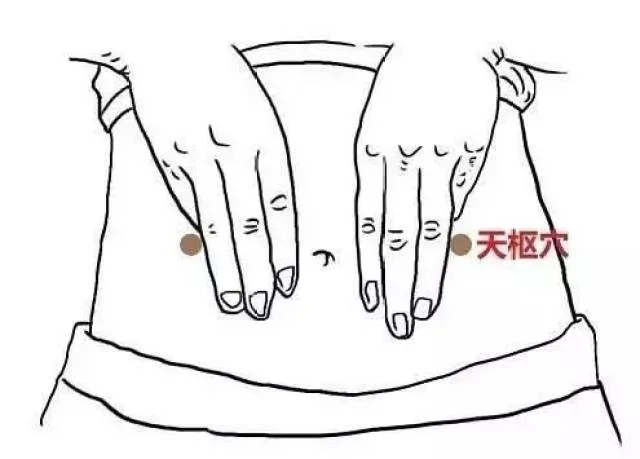
ST25 is on the abdomen, two cun lateral to the center of the belly button — about three of your own finger-widths out from the navel, on the same horizontal line. Find your navel and place three fingers beside it; the point is where the outer edge of your little finger lands, on a line level with the navel, on both the left and right sides. Pressing gently you will feel a soft tissue area just outside the belly button, and it may feel slightly more tender or "busy" than the surrounding abdomen.
Three quick confirmations you have the right spot: (1) the point sits level with the navel, not above or below it; (2) the two points lie symmetrically on the left and right; (3) it feels slightly more tender or "busy" than the surrounding abdomen when pressed gently.
When to Use ST25 (and When Not)
Use it when
- • You are constipated, or your bowels feel sluggish
- • You have loose stools and want to help settle the abdomen
- • You feel bloated, distended, or full of trapped gas
- • You want a daily digestive-maintenance point or period-cramp support
Hold off if
- • You are pregnant — abdominal pressure is used very gently or avoided then
- • You have had recent abdominal surgery or have a hernia near the navel
- • You have severe, acute abdominal pain that is not explained
- • Massage makes the pain or cramping worse
Use the Hold off column as a safety filter: ST25 is a gentle digestive-regulating practice, not first aid for a sudden or severe abdomen.
What Are the Benefits?
- Constipation: ST25 is the primary acupressure point for sluggish bowels and difficulty passing stool.
- Diarrhea: Also used traditionally to calm loose stools and settle the abdomen.
- Bloating and gas: Helps relieve abdominal distension and trapped gas.
- Indigestion: Traditionally used for sluggish digestion and abdominal discomfort after meals.
- Menstrual cramps: Frequently included in routines for period pain and lower abdominal cramping.
How Do You Use This Point?
The best results come from slow, deliberate circular pressure matched to your breath. Let the abdomen stay soft and avoid forcing the point if it feels tender.
Step-by-step technique
- Lie on your back with your knees bent and feet flat so the abdominal wall relaxes.
- Place the middle fingers of both hands on the ST25 points, about three finger-widths out from the navel on each side.
- Apply slow, deep pressure and circle clockwise (following the natural direction of the colon) for 2–3 minutes.
- Keep your breathing even and relaxed, pressing a little deeper on each exhale.
- For constipation, repeat the clockwise massage 2–3 times daily, ideally in the morning or after a meal.
Common mistake to avoid: pressing too hard over a tender or full abdomen. ST25 works with slow, breath-matched circles, not force — and if pressure worsens the pain, stop and seek medical advice.
Combine ST25 with These Points
A digestive routine is more effective than pressing one point. Pick the row closest to your situation and work the points in the order shown, 2–3 minutes on the abdomen and 30–60 seconds on the limbs.
| Goal / symptom | Routine (in order) |
|---|---|
| Constipation | ST25 (clockwise 2–3 min) → ST36 → CV12, morning on waking and again after a meal |
| Diarrhea / loose stools | ST25 (gentle) → SP6 → ST36, using lighter pressure than for constipation |
| Bloating / trapped gas | ST25 → CV12 → LI4, holding each 30–60s until the abdomen settles |
| Menstrual cramps | ST25 → SP6 → LI4, 1–2 min each, 1–2 times daily around the period |
For a complete step-by-step plan, see our acupressure for constipation page and the abdomen acupressure points body guide. For weight support, ST25 is also used — see our weight loss guide.
What to Expect
First session (today)
Most people notice the abdomen feels looser and less bloated within a few minutes of clockwise massage. Do not expect an immediate bowel movement — ST25 is a regulator, and changes to bowel habits take a few days of consistent use.
Days 3–7 (consistent daily practice)
With 2–3 sessions per day, bowel regularity often improves and bloating eases. This matches the pattern in studies of abdominal acupressure for constipation, where benefits appear after several days of regular use alongside adequate hydration and fiber.
Weeks 2–4
For chronic constipation, pair ST25 with the rest of your routine — fluid, fiber, and movement. Acupressure is a complement, not a replacement for medical care. If constipation persists, or you notice blood in the stool or unexplained weight loss, see a doctor rather than continuing self-treatment.
What Does the Research Say?
Evidence on acupressure for digestive conditions has grown in recent years. Systematic reviews and randomized controlled trials have examined acupressure as an adjunct for constipation and postoperative bowel function, with results that are generally promising but limited in quality. Abdominal points such as ST25 and the area around the navel appear frequently in these protocols, and the direction of the massage is often part of the intervention design.
Researchers consistently note that acupressure trials are hard to blind, because the treatment is physical and participants can usually tell whether they are being treated. This makes it difficult to separate the specific effects of a particular point from the general benefits of touch, pressure, and relaxation. The overall picture — which we discuss in detail on our does acupressure work? review — is one of encouraging signals alongside a clear need for larger, higher-quality studies before firm conclusions can be drawn.
Acupressure has been evaluated in clinical trials for pain, nausea, anxiety, and sleep, with evidence described as promising but requiring further high-quality research.
— Lee EJ, Frazier SK. Journal of Pain and Symptom Management. 2011;42(4):589-603. PMID 21531533.
Verifiable sources
- Lee EJ, Frazier SK. The efficacy of acupressure for symptom management: a systematic review. Journal of Pain and Symptom Management. 2011;42(4):589-603. PMID 21531533 · DOI
The review above evaluated acupressure for symptom management, including digestive complaints. It is not a study of ST25 in isolation.
Are There Safety Concerns?
- Avoid strong abdominal pressure during pregnancy — ST25 should be used very gently or avoided then; consult a care provider first.
- Do not press if you have had recent abdominal surgery or have a hernia near the navel.
- Never press on acute, severe, or unexplained abdominal pain.
- Skip the point if there is skin irritation, a rash, or an open wound around the belly button.
- Stop if massage worsens abdominal pain or causes unusual cramping, and see a doctor for severe or persistent digestive symptoms.
Red Flags — See a Professional
Stop self-treatment and see a doctor if you notice any of the following:
- Severe, sudden, or worsening abdominal pain
- Blood in the stool, or black, tarry stools
- Constipation or diarrhea lasting more than a few weeks, with unexplained weight loss
- Vomiting, fever, or an abdomen that feels hard and tender to the touch
- No bowel movement combined with worsening pain, bloating, or vomiting