LV3 (Taichong) — Great Surge
LV3, known as Taichong or Great Surge, is the source point of the Liver meridian, sitting in the hollow on the top of the foot between the first and second toe bones. It is the point to reach for when stress, irritability, and tension headaches are building up and you need to let off steam.
At a Glance
| Meridian | Liver (LV) |
|---|---|
| Body region | Top of the foot, in the hollow before the junction of the 1st and 2nd metatarsals |
| Best for | Stress, headaches, premenstrual discomfort, irritability, blood-pressure support |
| Difficulty | Easy to reach barefoot with your thumb |
| Hold time | 45–60 seconds per foot |
| Frequency | Daily, or 1–2 times during stressful periods |
| Pairs well with | LI4 (Hegu) as the "Four Gates", GB20 (Fengchi), SP6 (Sanyinjiao) |
| Skip if | Recent injury to the top of the foot or broken skin over the point (see Precautions) |
Why LV3 Matters
LV3 is the go-to point for stress-related irritability, frustration, and that pent-up feeling of being "stuck." In traditional Chinese medicine, the Liver governs the smooth flow of Qi, and when stress disrupts that flow, LV3 helps restore it. It sits on top of the foot between the first and second toe bones, where it is easy to find and easy to press — which is exactly why it shows up in our routines for stress, headaches, and premenstrual tension again and again.
Traditional practice uses LV3 to redirect energy downward and calm the nervous system, especially for headaches linked to stress, anger, or Liver Qi stagnation. Paired with LI4 on the hand it forms the classic "Four Gates," a combination traditionally used to move stuck Qi through the whole body. Many people find LV3 grounding and feel noticeably more centered — and less ready to snap — after pressing it.
Where Is This Point Located?
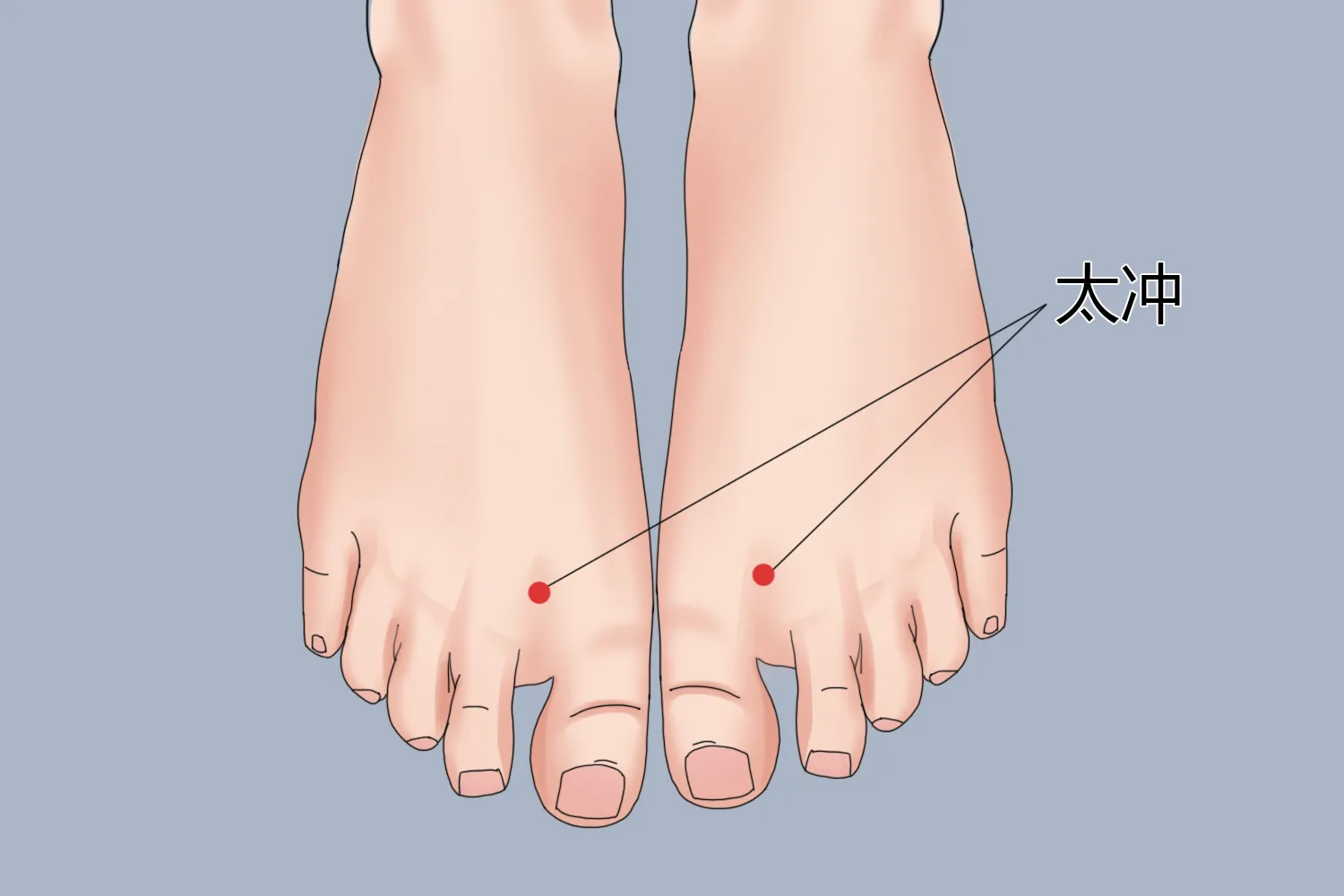
LV3 is on the top of the foot, in the depression between the first and second metatarsal bones, about 1 cun (one thumb width) from the web of the toes, at the front of the junction where the two bones meet. To find it, run a finger up from the web between the big and second toes until the bones come together — the point sits in the natural hollow just before that junction.
Three quick confirmations you have the right spot: (1) it is the soft depression on the top of the foot, roughly one thumb width from the web of the toes; (2) pressing it produces a distinctly tender, sometimes achy sensation that is stronger than the surrounding skin; (3) the tenderness often feels like it mirrors your level of stress — the point tends to be more sensitive on tense days.
When to Use LV3 (and When Not)
Use it when
- • Stress has you feeling irritable, frustrated, or wound up
- • You have a tension headache, especially one that builds with stress
- • Premenstrual discomfort, cramps, or mood swings are building
- • You want a relaxing support alongside blood-pressure or migraine care
Hold off if
- • You recently injured the top of the foot or ankle
- • The skin over the point is broken, cut, or has a rash
- • The foot is swollen, warm, or acutely painful
- • Pressure causes a shooting pain or numbness into the toes
Use the Hold off column as a safety filter: LV3 is a comfort practice for stress and tension, not first aid for an acute foot injury. During pregnancy, foot pressure on LV3 should stay light.
What Are the Benefits?
- Stress and irritability: LV3 is the go-to point for releasing pent-up frustration, anger, and emotional tension.
- Headaches: It is especially helpful for headaches that build with stress or blood-pressure changes.
- Premenstrual discomfort: LV3 helps ease cramps and mood swings by moving Liver Qi.
- Blood-pressure support: Regular, gentle stimulation promotes relaxation, which supports blood-pressure management as part of a doctor-led plan.
- Restoring smooth flow: As a source point, LV3 helps unblock the stuck, "wound-up" feeling that comes with chronic stress.
How Do You Use This Point?
Press into the hollow on the top of the foot with your thumb in small, steady circular motions. The top of the foot is more delicate than the sole, so build pressure slowly and favor a deep, dull ache over force.
Step-by-step technique
- Sit comfortably and place your foot on your opposite knee.
- Slide your finger up from between the big and second toes to find the hollow before the bones meet.
- Use your thumb to apply firm, steady pressure in a slow circular motion.
- Hold for 45–60 seconds, breathing deeply, then switch to the other foot.
- Repeat daily, or two or three times during stressful periods.
Common mistake to avoid: pressing into the web of the toes or directly onto the bony ridge instead of the hollow before the bone junction. The target sensation is a deep, dull, spreading ache in the soft depression — if you feel a sharp pinch against bone, ease off.
Combine LV3 with These Points
LV3 releases stuck energy best as part of a routine. Pick the row closest to your situation and work the points in the order shown, 45–60 seconds each.
| Goal / symptom | Routine (in order) |
|---|---|
| Stress, frustration, feeling stuck | LV3 → LI4 (Hegu) — the "Four Gates" — then SP6, 60s each |
| Stress-related tension headache | GB20 → LI4 → LV3, holding each 60s for up to 3 minutes total |
| Premenstrual tension and cramps | LV3 → SP6, 60s each, daily in the days before your period, with warmth on the lower belly |
| Evening wind-down after a stressful day | LV3 → KI1 → HT7, 60s each, before bed |
For a fuller program, see the acupressure for headache page and the foot acupressure points body guide.
What to Expect
First session (today)
LV3 is usually markedly tender, especially on stressful days. Most people notice a quick sense of release and grounding within a few minutes, though the effect can wear off as the day's stressors return. Treat the first session as a taste, not a cure.
Days 3–7 (consistent daily practice)
With daily use, the tenderness at the point usually eases and the "wound-up" feeling often becomes less intense. This matches the pattern in studies of acupressure for stress and tension, where benefits tend to appear after several days of regular practice rather than a single session.
Weeks 2–4
For chronic stress or recurring tension headaches, LV3 works best as part of a broader routine that includes sleep, movement, and stress management. If headaches are frequent, severe, or worsening, or if stress is interfering with daily life, see a clinician — pressure on a foot point is not a substitute for proper care.
What Does the Research Say?
Evidence on acupressure for stress, headache, and pain has grown in recent years. Systematic reviews and randomized controlled trials have examined acupressure as an adjunct for these conditions, with results that are generally promising but limited in quality. Meta-analyses of acupressure for headache and stress tend to show a positive direction of effect, though many of the included studies are small and their methodological quality varies considerably.
Researchers consistently note that acupressure trials are hard to blind, because the treatment is physical and participants can usually tell whether they are being treated. This makes it difficult to separate the specific effects of a particular point such as LV3 from the general benefits of touch, pressure, and relaxation. The overall picture — which we discuss in detail on our does acupressure work? review — is one of encouraging signals alongside a clear need for larger, higher-quality studies before firm conclusions can be drawn. For headaches specifically, our acupressure for headache page summarizes the strongest available evidence.
Acupressure has been evaluated in clinical trials for pain, nausea, anxiety, and sleep, with evidence described as promising but requiring further high-quality research.
— Hsieh LL, Liou HH, Lee LH, Chen TH, Yen AM. American Journal of Chinese Medicine. 2010;38(1):1-14. PMID 20128040.
Verifiable sources
- Hsieh LL, Liou HH, Lee LH, Chen TH, Yen AM. Effect of acupressure and trigger points in treating headache: a randomized controlled trial. American Journal of Chinese Medicine. 2010;38(1):1-14. PMID 20128040 · DOI
- Chen YW, Wang HH. The effectiveness of acupressure on relieving pain: a systematic review. Pain Management Nursing. 2014;15(2):539-550. PMID 23415783 · DOI
The trial and review above evaluated acupressure for headache and for pain, the conditions LV3 is most used for. Neither is a study of LV3 in isolation.
Are There Safety Concerns?
- Avoid if you recently injured the top of the foot or ankle, or if the area is swollen and painful.
- Do not press over broken skin, cuts, rashes, or blisters on the top of the foot.
- Avoid pressing too hard — the bones on top of the foot are delicate and the area is sensitive.
- During pregnancy, keep foot pressure light; LV3 is not a forbidden point in pregnancy, but foot work should stay gentle.
- Stop if you feel sharp pain or numbness in the toes.
Red Flags — See a Professional
Stop self-treatment and see a doctor if you notice any of the following:
- A headache that is sudden, severe, or the worst you have ever had
- Headaches accompanied by vision changes, confusion, or weakness on one side
- Irritability, mood swings, or anger that is harming relationships or daily function
- Foot pain, swelling, or an injury that appeared suddenly
- No improvement after 2–3 weeks of regular acupressure and stress management
Frequently Asked Questions
How do I find LV3 on myself?
How long and how often should I press LV3?
Can LV3 help with migraines?
Is LV3 safe during pregnancy?
Can I press LV3 at work?
When should I see a doctor instead of using LV3?
Related guides: acupressure for stress relief, migraine, tinnitus, and high blood pressure (support only).