KD3 (Taixi) — Great Stream
KD3, known as Taixi or Great Stream, is the source point of the Kidney meridian, sitting in the hollow between the inner ankle bone and the Achilles tendon. It is the point to reach for when you feel run down, chronically tired, or battling a dry, sore throat that never quite clears.
At a Glance
| Meridian | Kidney (KI/KD) |
|---|---|
| Body region | Inner ankle, midway between the ankle bone and the Achilles tendon |
| Best for | Fatigue, sore throat, weak lower back and knees, insomnia, kidney-deficiency tiredness |
| Difficulty | Easy to reach barefoot with your thumb |
| Hold time | 1–2 minutes per ankle |
| Frequency | 1–2 times daily |
| Pairs well with | KI1 (Yongquan), BL23 (Shenshu), SP6 (Sanyinjiao) |
| Skip if | Recent ankle injury or broken skin over the inner ankle (see Precautions) |
Why KD3 Matters
KD3 is the source point of the Kidney meridian, which traditional Chinese medicine links to the deep reserves of energy behind vitality, and to the Yin fluids that moisten the throat. It sits just behind the inner ankle, between the ankle bone and the Achilles tendon, and it shows up in our foot routines whenever the theme is Kidney energy, fatigue, or that bone-tired feeling that rest does not fix. Because the Kidneys are classically said to govern the bones and marrow, KD3 is also a traditional stop for weak knees and a tired, aching lower back.
KD3 is easy to reach barefoot and pairs naturally with the rest of the foot region's grounding work. It combines with KI1 for deep fatigue, with BL23 on the lower back for lumbar tiredness, and with SP6 and HT7 for sleep and stress. If you have been running on empty for weeks and your body feels like it is asking for a recharge, KD3 is usually the first point practitioners reach for.
Where Is This Point Located?
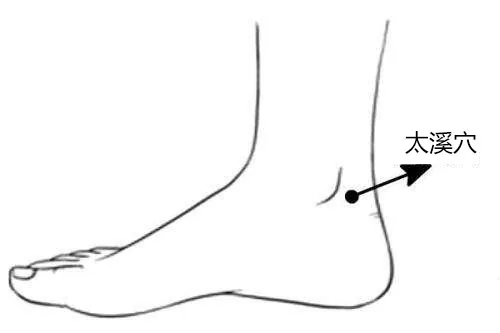
KD3 is on the inner ankle, in the depression between the medial malleolus (inner ankle bone) and the Achilles tendon, level with the top of the ankle bone. The hollow sits roughly midway between the bone and the tendon — not pressed into either ridge. Because the point sits close to bone and tendon, ease off rather than digging into the edge.
Three quick confirmations you have the right spot: (1) it is the soft depression centered between the inner ankle bone and the Achilles tendon, level with the top of the bone; (2) it is distinctly tender compared with the skin around it; (3) pressing toward the bone with a slow, steady thumb produces a deep, achy sensation that may feel like it spreads up the leg.
When to Use KD3 (and When Not)
Use it when
- • You feel deeply fatigued and running on empty for weeks
- • Your throat is dry, sore, or scratchy and nothing seems to help
- • Your lower back and knees feel weak, tired, or achy
- • You want a grounding Kidney point in a bedtime or fatigue routine
Hold off if
- • You recently sprained or injured the inner ankle
- • The skin over the point is broken, cut, or has a rash
- • The ankle is swollen, warm, or acutely painful
- • Pressure causes a shooting pain or numbness down the foot
Use the Hold off column as a safety filter: KD3 is a restorative practice for chronic tiredness and dryness, not first aid for an acute ankle injury.
What Are the Benefits?
- Kidney energy: KD3 nourishes Kidney yin and yang, supporting vitality and adrenal reserve.
- Chronic fatigue: It helps restore energy levels in those experiencing burnout or exhaustion.
- Sore throat: KD3 moistens the throat and is a traditional point for dry, scratchy throats that linger.
- Lower back and knees: It strengthens a tired, weak lower back and supports wobbly knees.
- Insomnia: As a Kidney Yin point, KD3 helps quiet a restless mind and supports sleep.
How Do You Use This Point?
Press with your thumb at roughly 90 degrees to the skin, deepen slowly until you feel the deep, dull ache practitioners call deqi, then hold with even breathing. The ankle area is more delicate than the sole, so steady and slow beats hard.
Step-by-step technique
- Sit with your leg comfortably positioned to reach the inner ankle.
- Place your thumb on the KD3 point between the ankle bone and the Achilles tendon.
- Apply firm, steady pressure with a gentle circular motion.
- Hold for 1–2 minutes, breathing slowly, then switch to the other ankle.
- Repeat once or twice daily as part of a fatigue, throat, or bedtime routine.
Common mistake to avoid: pressing directly into the bone or the tendon edge instead of the hollow between them. The target sensation is a deep, dull, spreading ache in the soft depression — if you feel a sharp pinch against bone or a shooting pain, ease off.
Combine KD3 with These Points
KD3 restores best as part of a routine. Pick the row closest to your situation and work the points in the order shown, 1–2 minutes each.
| Goal / symptom | Routine (in order) |
|---|---|
| Deep fatigue and burnout | KD3 → KI1 → BL23 (Shenshu), 1–2min each, morning and evening |
| Poor sleep and a restless mind | KD3 → HT7 → SP6, as a nightly bedtime sequence |
| Weak, tired lower back | BL23 → KD3 → BL40, 60s each, alongside gentle movement |
| Dry, scratchy throat | KD3 → SP6, 2min each, 2–3 times daily, with warm fluids and rest |
For a fuller program, see the foot acupressure points body guide and our acupressure for sleep page.
What to Expect
First session (today)
The point is usually noticeably tender, and the deep, achy sensation can be surprising at first. Many people feel a general sense of release or warmth in the ankle area within a few minutes. Do not expect your energy to return after a single press — the first session is mostly about learning the spot.
Days 3–7 (consistent daily practice)
With 1–2 sessions per day, the tenderness at the point usually eases, and people often report feeling a bit less drained and sleeping more soundly. This matches the pattern in studies of acupressure for fatigue and sleep, where benefits tend to appear after several days of regular use.
Weeks 2–4
For chronic fatigue, KD3 works best as one piece of a broader plan that includes sleep, food, and movement. If you are still exhausted after 2–3 weeks, or if fatigue is accompanied by weight loss, fever, or shortness of breath, see a clinician — persistent tiredness deserves a proper workup rather than more pressure.
What Does the Research Say?
Evidence on acupressure for fatigue, sleep, and pain has grown in recent years. Systematic reviews and randomized controlled trials have examined acupressure as an adjunct for these conditions, with results that are generally promising but limited in quality. Meta-analyses of acupressure for fatigue and sleep tend to show a positive direction of effect, though many of the included studies are small and their methodological quality varies considerably.
Researchers consistently note that acupressure trials are hard to blind, because the treatment is physical and participants can usually tell whether they are being treated. This makes it difficult to separate the specific effects of a particular point such as KD3 from the general benefits of touch, pressure, and relaxation. The overall picture — which we discuss in detail on our does acupressure work? review — is one of encouraging signals alongside a clear need for larger, higher-quality studies before firm conclusions can be drawn. For sleep and anxiety specifically, our acupressure for anxiety page and acupressure for sleep page summarize the strongest available evidence.
Acupressure has been evaluated in clinical trials for pain, nausea, anxiety, and sleep, with evidence described as promising but requiring further high-quality research.
— Chen HM, Wang HH, Chiu MH, Hu HM. Journal of Alternative and Complementary Medicine. 2022;28(5):514-524. PMID 35235358.
Verifiable sources
- Chen HM, Wang HH, Chiu MH, Hu HM. Effects of acupressure on anxiety: a systematic review and meta-analysis. Journal of Alternative and Complementary Medicine. 2022;28(5):514-524. PMID 35235358
The meta-analysis above evaluated acupressure for anxiety, which is the context where KD3 is often used. It is not a study of KD3 in isolation.
Are There Safety Concerns?
- Avoid if you recently sprained or injured the inner ankle, or if the joint is swollen and painful.
- Do not press over broken skin, cuts, rashes, or blisters on the inner ankle.
- Use gentle pressure — the area between the ankle bone and tendon contains sensitive nerves and blood vessels.
- Stop if you feel a sharp or shooting pain, or numbness spreading into the foot.
Red Flags — See a Professional
Stop self-treatment and see a doctor if you notice any of the following:
- Fatigue so profound that it interferes with daily life, or fatigue that follows an illness
- Fatigue together with unexplained weight loss, fever, or night sweats
- A sore throat that is severe, lasts more than a couple of weeks, or makes swallowing difficult
- Ankle swelling, warmth, or pain that appears suddenly after an injury
- No improvement after 2–3 weeks of consistent acupressure and rest
Frequently Asked Questions
How do I find KD3 on myself?
How long and how often should I press KD3?
Can KD3 help with a dry, sore throat?
Is KD3 safe to use for tired lower back and knees?
Can I press KD3 at work or on the go?
When should I see a doctor instead of using KD3?
Related guides: acupressure for high blood pressure (support only).